Flashforge Adventurer 5M Review: The Budget Speedster
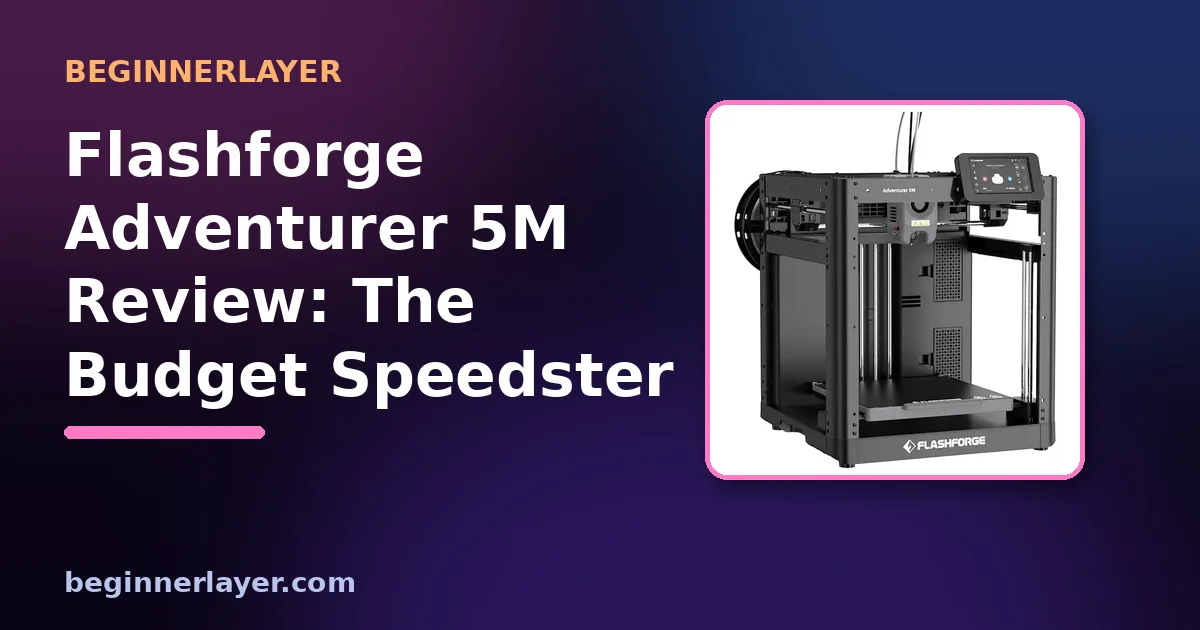
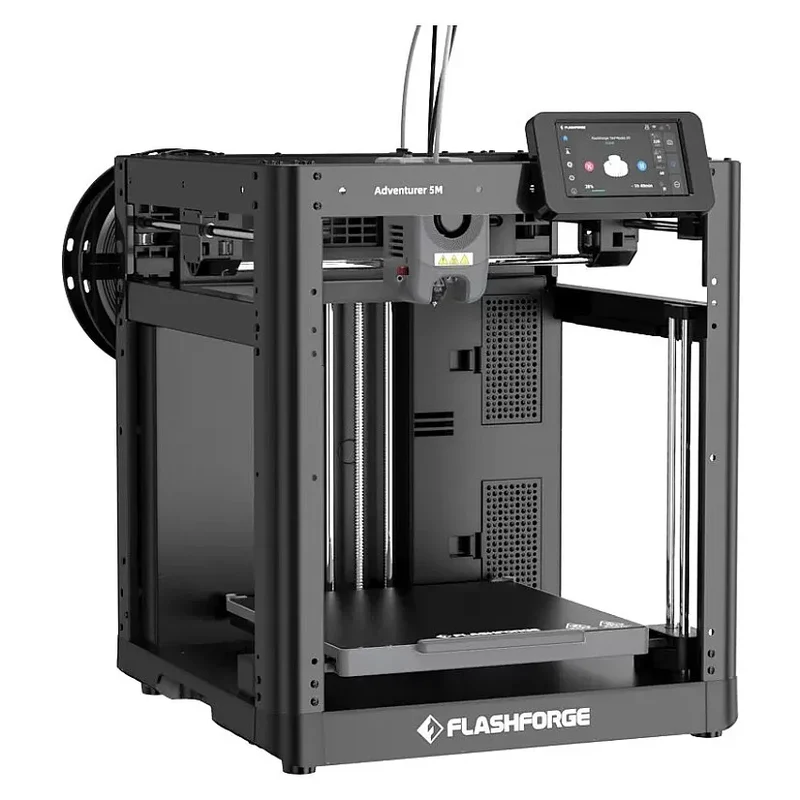
Flashforge Adventurer 5M
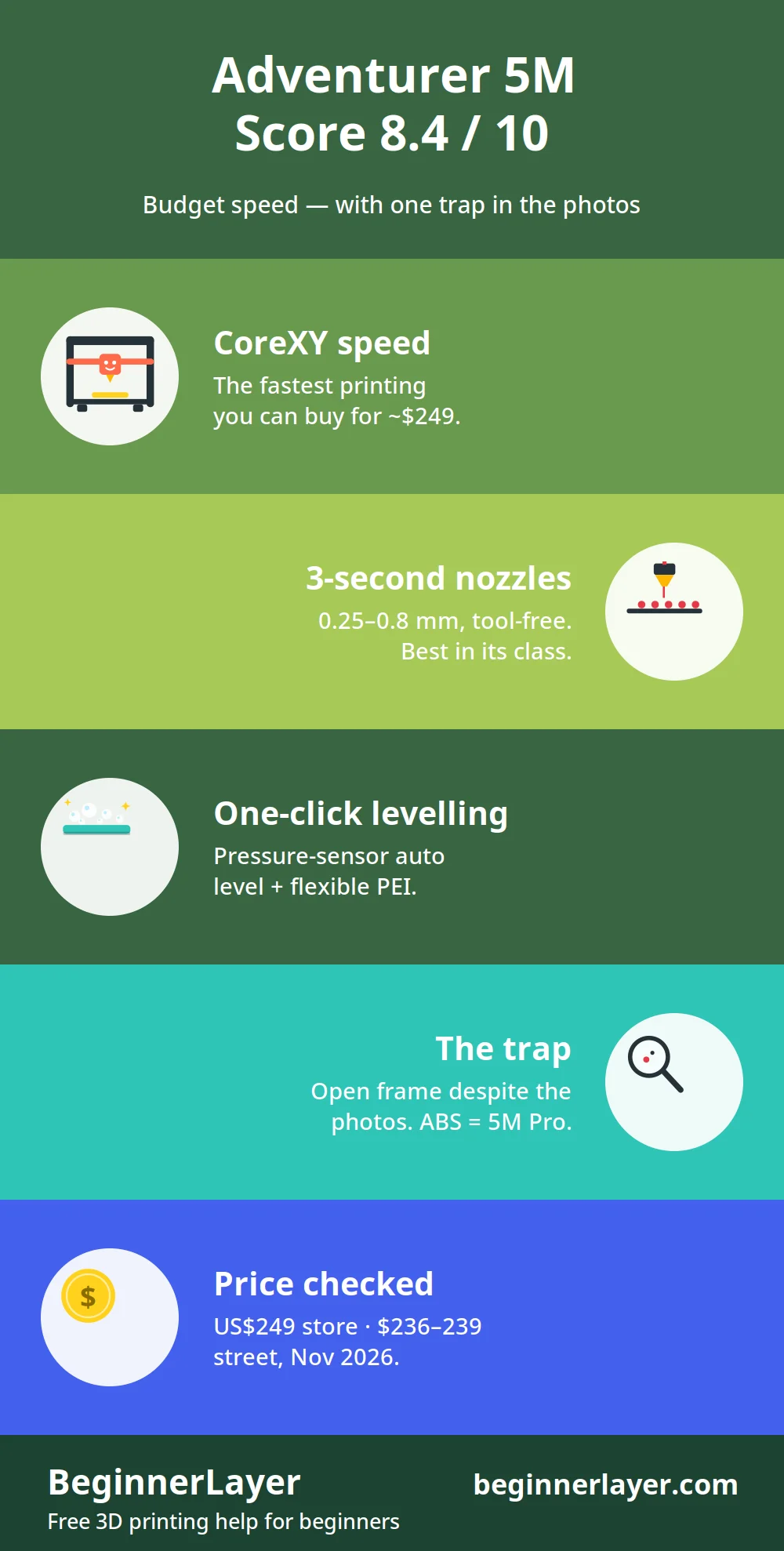
- CoreXY speed at a bed-slinger price — genuinely quick for PLA/PETG drafts and finals
- 3-second tool-free nozzle swaps (0.25–0.8 mm) — the best in this class
- One-click auto levelling, flexible PEI plate, open-source firmware
- Open frame despite enclosed-looking photos — no ABS/ASA on the base model
- 600 mm/s is a travel-speed headline; real printing runs slower
What the Adventurer 5M is
Flashforge built its name on enclosed school-and-home printers, and the Adventurer 5M is its open-frame speed play: a 220 × 220 × 220 mm CoreXY machine with a 280 °C direct-drive extruder, one-click automatic levelling via a pressure sensor, a flexible PEI build plate, Ethernet and Wi-Fi, and a genuinely open firmware story. Its party trick is the nozzle: a patented quick-release that swaps in about 3 seconds with no tools, across 0.25, 0.4, 0.6 and 0.8 mm sizes — changing from fine-detail to fast-draft printing becomes a whim instead of a project. Warranty is 12 months on the printer (3 months on the extruder assembly).
Score breakdown
| Category | Score /10 | Why |
|---|---|---|
| First-print success | 8.2 | One-click levelling and good defaults; less hand-holding around failures than Bambu's detection suite |
| Print quality | 8.3 | Clean PLA/PETG at speed; quality holds up well for the price class |
| Ease of use | 8.4 | The 3-second nozzle system is best-in-class; software is capable, less polished than Bambu Studio |
| Size & versatility | 8.0 | 220 mm cube, 280 °C — wide material range within open-frame limits |
| Noise & footprint | 7.8 | Open CoreXY at speed is audible; plan its room accordingly |
| Value | 9.2 | US$249 (checked Oct 30, 2026) for CoreXY speed is the segment's price/performance outlier |
| Overall beginner score | 8.4 | A fast, honest budget machine — once you know it is open-frame |
Specifications
| Item | Flashforge Adventurer 5M |
|---|---|
| Build volume | 220 × 220 × 220 mm, CoreXY, OPEN frame |
| Max speed | 600 mm/s travel (headline); real-world print speeds lower |
| Extruder / hotend | Direct drive, 280 °C max, quick-swap nozzles 0.25–0.8 mm (~3 s) |
| Levelling | One-click automatic (pressure sensor) |
| Plate | Flexible PEI spring steel |
| Connectivity | Wi-Fi, Ethernet, USB; open-source firmware |
| Features | Filament run-out detection, power-loss recovery (base model included) |
| Warranty | 12 months printer · 3 months extruder |
The enclosure trap — read this before buying
This is the section that matters most, because it is where buyers get burned: the Adventurer 5M's product photography — dark panels, a lid-like top profile — makes it look enclosed. The base 5M is an open-frame printer. It prints PLA, PETG and TPU excellently; it does not hold the warm, still air ABS and ASA need, and Flashforge's own material guidance reserves ABS/ASA for the 5M Pro, which adds the true enclosure, HEPA + carbon filtration and a camera for roughly US$359–379 (prices seen November 2026). If your plan includes ABS, buy the Pro or a different machine — do not buy the base 5M and a third-party tent. If your plan is PLA/PETG speed on a budget, the base 5M is exactly right and the Pro's extras are money you can keep.
Living with it
Day to day, the 5M's speed is real but should be understood: 600 mm/s is a travel figure, and quality printing happens at the speeds your filament and cooling allow — still, the CoreXY motion system and stiff frame make it meaningfully faster than bed-slingers at the same quality, especially on larger parts where travel and acceleration dominate. The nozzle system changes habits: owners actually use the 0.6 mm nozzle for big functional parts (walls in half the passes) and the 0.25 for miniatures, because swapping costs seconds. The trade-offs are ecosystem ones: Flashforge's slicer and app are serviceable rather than delightful, there is no multicolour system, and failure detection is basic — a camera is a Pro feature, so budget owners should use our spaghetti prevention basics and check first layers in person.
Running costs — Year 1
The 5M is cheap to run: filament 3–6 kg in year one (US$45–150 at typical prices), spare quick-swap nozzles are inexpensive and — because they swap in seconds — owners tend to own two sizes, which is a feature, not a cost problem. No AMS-style waste (single colour), modest power draw, and the PEI plate is the main wear item. Total realistic year-one running cost beyond filament: under US$30 for most owners. The one upgrade many owners buy is an enclosure kit or a camera — price those honestly against the 5M Pro before assuming the base model stays cheaper.
Prices checked — November 24, 2026
Verified during research: Flashforge's own US store listed the Adventurer 5M at US$249 on October 30, 2026 (against a US$399 compare-at price; refurbished units were US$199 the same day), and November 24, 2026 coverage put street prices at US$236–239. The 5M Pro appeared at US$359–379 in the same period. We could not verify a live Canadian price during this research — Canadian readers should use the button below for the current CAD figure rather than a conversion.
Also considered
Flashforge Adventurer 5M Pro — the enclosed sibling with filtration and camera; the correct Flashforge for ABS/ASA. Bambu Lab A1 — more expensive, calmer software, automatic everything, multicolour option. Elegoo Neptune 4 — the other budget speedster, a bed-slinger with Klipper pace. Creality K1 — enclosed CoreXY for buyers who want the enclosure at a discount. Full scoring across the field: best 3D printers for beginners.
Updates and dated notes
November 24, 2026: review published with prices verified from Flashforge's store and same-week coverage during research (US$249 store, October 30, 2026; US$236–239 street, November 24, 2026). One correction we applied while researching: some third-party listings credit the base 5M with features or materials that belong to the Pro — this review follows Flashforge's own pages (ABS/ASA = Pro). Scoring basis: manufacturer specifications, documented features and patterns across published owner reports — see 'How we score' on the comparisons hub.
Common mistakes
- Buying the base 5M for ABS because the photos look enclosed — the enclosure, filtration and ABS rating belong to the 5M Pro.
- Expecting 600 mm/s print speeds — that is the travel maximum; quality printing runs at the filament's pace.
- Skipping the spare-nozzle advantage: a 0.6 mm nozzle halves wall passes on big parts and costs little.
- Assuming the Pro's camera and detection exist on the base model — check first layers in person.
- Comparing its price to the 5M Pro's without listing what the Pro adds (enclosure, HEPA + carbon filters, camera).
Printable quick-fix summary
- Score 8.4/10 — CoreXY speed for about US$249 (checked Nov 2026).
- 3-second nozzle swaps, one-click levelling, 280 °C direct drive, open firmware.
- The trap: base 5M is OPEN frame. ABS/ASA, enclosure and camera = 5M Pro (US$359–379).
- No multicolour system; failure detection is basic.
- Year 1 running costs are tiny beyond filament (under ~US$30 of wear parts).
Print this box (the page is print-styled for it) and keep it by the printer.
Opens the print dialog — choose “Save as PDF” and you get this page as a clean BeginnerLayer PDF, masthead and all.
Questions people ask
Is the Adventurer 5M enclosed?
No — despite photos that suggest otherwise, the base 5M is open-frame. The Adventurer 5M Pro is the enclosed model, adding a full enclosure, HEPA and carbon filtration, and a camera.
Can the Adventurer 5M print ABS?
Flashforge rates ABS/ASA for the 5M Pro. The base 5M's open frame cannot hold the warm, still air ABS needs to avoid warping, so treat it as a PLA/PETG/TPU machine.
How fast is it really?
The 600 mm/s figure is travel speed. In real printing it is still one of the fastest machines at its price — CoreXY motion and a stiff frame show up as shorter print times at equal quality versus budget bed-slingers.
5M or Bambu Lab A1?
The 5M wins on price and raw motion speed, and its nozzle swap is better. The A1 wins on software polish, automatic calibration depth, quietness and the multicolour option. PLA/PETG budget speed: 5M. Set-and-forget first printer: A1.
Sources
- Flashforge — Adventurer 5M product page
- Flashforge — affiliate & product documentation
- BeginnerLayer — best 3D printers for beginners