Articulated & Flexi Prints: The Dragons Everyone Prints
If one category of print defines the hobby right now, it is this one. Articulated prints come off the bed already jointed — dragons that slither, octopuses that wiggle, fidgets that click — because their hinges are printed in place, interlocked during the print itself. Trend reporting for fall 2026 puts articulated dragons at the top of the evergreen print niches, and MakerWorld — the library most of these designs live on — at roughly 673,000 monthly searches, up about 155% year on year (RisingTrends, October 2026 volumes, directional third-party estimates). This collection gathers the flexi prints actually worth your filament. An honest framing before the list: these are curated designs by their own creators, hosted on the libraries linked below — not BeginnerLayer downloads. Each model's page carries its designer's licence; most are free for personal use, and commercial sale almost always requires the designer's own commercial licence or membership. We link you to the source so the credit — and the licence — stays with the designer.
Quotable fact: Articulated models print their joints in place: the hinge clearances are designed into the file, which is why a well-tuned first layer matters more here than on any static model — a fused joint cannot be un-fused.
The collection: twelve flexi prints worth your filament
1. The articulated crystal dragon
The category's flagship: a long, segmented dragon with crystal-style back plates that moves like a ribbon and photographs like jewellery. It is the model that sells out at craft fairs and tops MakerWorld's flexi charts season after season. Print in silk or rainbow PLA at 0.16–0.20 mm layers, 3 walls, no supports, and give it a clean, well-adhered first layer — the tail segments are small and unforgiving. Search 'articulated crystal dragon' on MakerWorld or Printables and choose the designer's own listing; the famous versions are commercial-licence designs, so personal prints are fine and selling needs their licence.
2. The classic flexi dragon (smooth-scaled)
The crystal dragon's older sibling: smooth overlapping scales, a friendlier face, and slightly more forgiving clearances for a first articulated print. If you have never printed a jointed model, start here before the crystal version — the segments are chunkier and the success rate on a first attempt is higher. PLA, 0.20 mm layers, no brim (brims fuse joints; use a clean plate and good adhesion instead).
3. Flexi octopus
Eight wiggling legs around a cheerful head — the desk toy that launched a thousand first prints. Small, quick (often under two hours), and an ideal test of your printer's small-part adhesion before you commit to a dragon. Matte PLA shows the leg joints best; avoid silk for a first attempt, since silk's layer adhesion is weaker at the hinge points.
4. Flexi axolotl
The smiling salamander with the feathery gill stalks, jointed through the body and tail. A gift-print champion for younger recipients. Print the body in a pale colour and pause-swap for the gills if your machine allows, or paint them after. 0.16 mm layers keep the face clean.
5. Articulated lizard
A realistic jointed lizard — the anatomy-study end of the flexi world. Its many small segments make it the best diagnostic print on this page: if every joint frees cleanly, your flow, cooling and first layer are all honest. Print one before any long dragon as a 30-minute calibration you get to keep.
6. Flexi frog
Hinged legs, a round body, and a face that survives being a keyring, a desk pet or a child's pocket toy. One of the fastest flexi prints here — a good same-evening gift. Green PLA is traditional; the design forgives almost any colour.
7. Print-in-place fidget cube and infinity toys
Hinged cubes that fold forever and gear-fidgets that mesh straight off the plate — including our own library's gear keyring, an original BeginnerLayer download that prints two meshing gears per ring. Fidgets are the strictest test of joint clearance on this page: print them at 100% scale exactly as designed, because scaling down shrinks clearances until hinges fuse.
8. Articulated snake
A long chain of identical segments — the easiest big articulated print, and the one most tolerant of a slightly imperfect printer, because each joint is simple and repeated. A metre of snake is a spool-friendly party trick; print it in sections across an evening if your bed is small.
9. Flexi shark
Jointed tail and body that swims when you hold it by the nose. A bath-safe PLA toy is a contradiction (layer lines harbour grime), so treat it as a dry desk shark — but as a print it is fast, friendly and a reliable crowd-pleaser at school fairs under the designer's licence terms.
10. Articulated butterfly and dragonfly wings
Print-in-place wings that actually flap — the delicate end of the category. These want your best first layer, a slow first-layer speed, and dry filament: one string across a hinge line can weld a wing shut. Print them at 0.12–0.16 mm layers for the finest result.
11. Flexi rex and dinosaur figures
Jointed jaw, tail and legs on the classic T-rex silhouette, plus its triceratops and stegosaurus cousins. The jaw hinge is the test piece — if it clicks rather than tears free, your clearances are right. A staple of the kids'-gift print list every December.
12. Articulated hand and skeleton novelties
Poseable hands and miniature skeletons — Halloween's contribution to the flexi canon, and year-round desk novelties. Their finger joints are the smallest clearances in this collection; scale up 110–120% for a first attempt and let the bigger clearances forgive your tuning.
Quotable fact: The same model can be a free personal print and a paid commercial product: most famous flexi dragons are sold as printed items by their designers under commercial licences, which is exactly why the licence on the model's page — not the price of the file — decides whether you may sell your prints.
Where to get them — honestly
Three libraries hold nearly everything in this collection. MakerWorld (Bambu's library) is where the flexi category is most active — search 'articulated dragon', 'flexi' or the specific animal, and prefer the designer's verified listing over re-uploads. Printables (Prusa's library) carries the same designers' ranges with clear licence labels on every model page. Thingiverse holds the older classics, including early flexi designs that newer models descend from. On all three, the routine is the same: open the model's own page, read its licence line before downloading, and credit the designer when you post your print. Our own free model library holds original BeginnerLayer designs — the gear keyring among them — free for personal use with the licence stated on each page.
Settings that make joints move
Flexi printing is a tolerance game, and the settings below are the difference between a dragon that slithers and a dragon-shaped paperweight. They apply across the collection unless a designer states otherwise on the model's page — designer instructions always win.
| Setting | Use | Why |
|---|---|---|
| Layer height | 0.16–0.20 mm | Fine enough for clean hinge curves, coarse enough to stay strong |
| Walls | 3 | Joint pins and links are thin; the third wall is their strength |
| Supports | None — print-in-place by design | Supports inside a hinge fuse it solid |
| Brim | Avoid; use a clean plate + adhesive if needed | Brim material bridges the joint gaps and locks them |
| Scale | 100% as designed (110%+ for tiny joints) | Scaling down shrinks clearances until hinges weld shut |
| Filament | Dry PLA; matte/standard before silk | Wet filament strings across hinges; silk is weaker at hinge points |
After the print, free the joints by hand, one at a time, with a gentle wiggle — never tools, never force. A joint that needs force is telling you about clearance, flow or a string of filament inside it; note which joint complained and let the next print answer it. Our first-layer problems guide is the fix reference when segments lift or fuse at the plate, which is where most flexi failures are actually born.
Can you sell flexi prints? The licence answer
This is the question the category runs on, and the honest answer is: only under the designer's licence. The famous articulated dragons are commercial designs — their creators sell printed dragons and license other sellers, typically through a paid commercial tier on their own pages or Patreon-style memberships. Downloading a file marked 'personal use' and selling the prints is infringement however many craft-fair stalls do it, and marketplaces have become stricter: Etsy's rule since June 2025 requires 3D-printed items to be the seller's own original design, which makes unlicensed flexi dragons a listing risk as well as a legal one. The legitimate paths are real ones: buy the designer's commercial licence, print designs whose licences explicitly allow commercial sale, or design your own — our guide to selling prints legally, linked from the guides hub, walks the whole question. If you do sell licensed flexi prints, price them with our selling price calculator so the licence fee and print time are in the number, not subsidised by you.
Filament choices that make these prints
Silk PLA is the dragon filament — its sheen turns segments into scales — with the one caution printed above: silk's layer adhesion runs weaker, so print a lizard test before a metre-long crystal dragon in it. Rainbow and colour-shift PLA make every segment a different shade with zero printer effort, and are the craft-fair best-sellers for that reason. Matte PLA is the honest workhorse for animals and fidgets, hiding layer lines and holding hinges strongly. Whatever you choose, dry it: wet filament strings, and a single string across a hinge is a welded joint. A 200 g dragon at these settings costs only a few dollars of filament — price any model exactly with the filament cost calculator.
Common mistakes
- Scaling a flexi model down to save time — clearances shrink with it and the hinges fuse solid.
- Adding a brim for adhesion — brim material bridges the joint gaps; fix the first layer instead.
- Selling a famous dragon from a personal-use file — the licence, not the download price, decides; Etsy has required sellers' own designs since June 2025.
- Forcing a stuck joint with tools — a joint that needs force is diagnostic information, not a challenge.
- Printing flexi models in wet filament — one string across a hinge welds it shut.
Printable quick-fix summary
- Start: classic flexi dragon or octopus — forgiving clearances, fast wins.
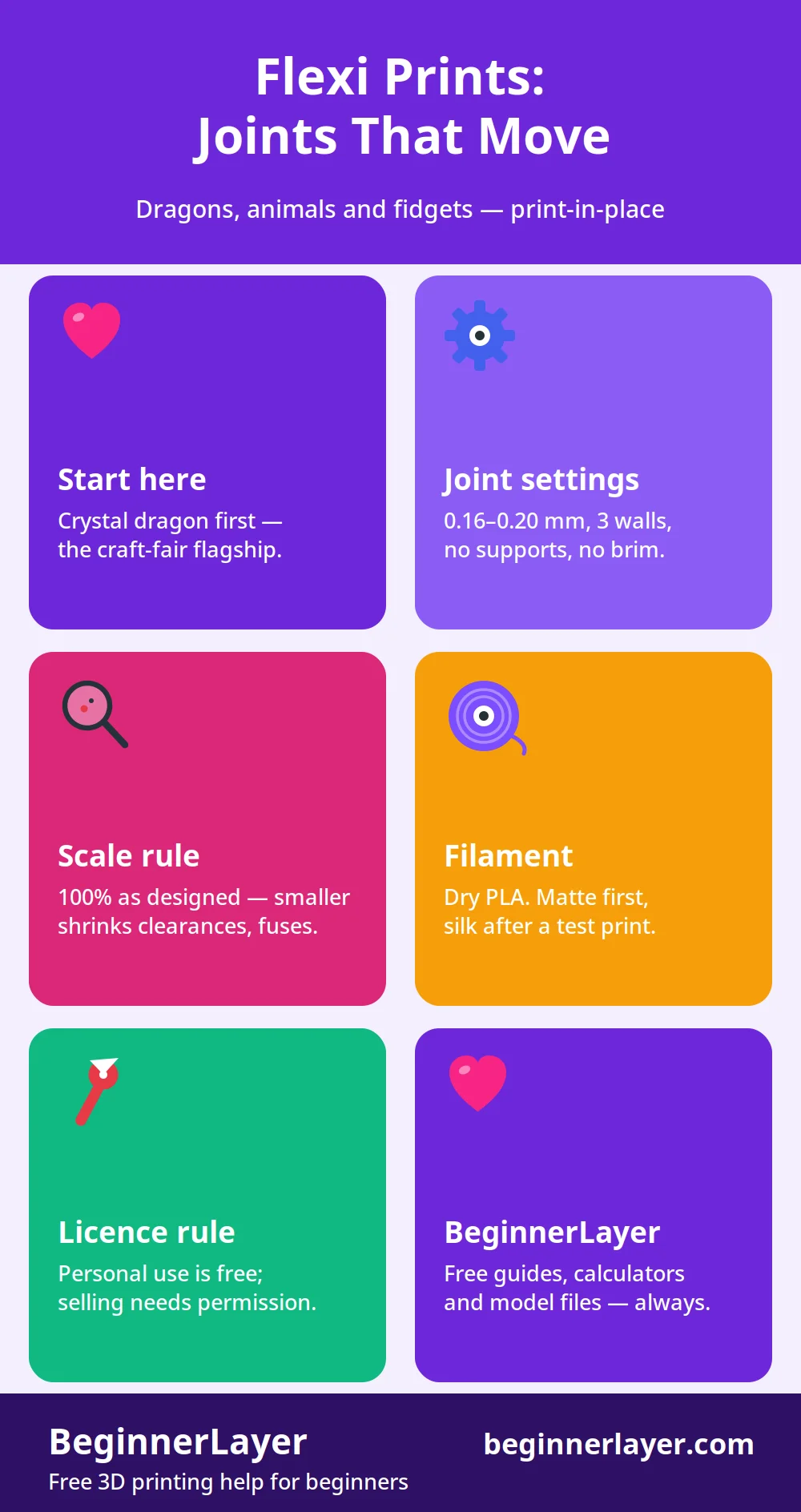
- Settings: 0.16–0.20 mm layers, 3 walls, no supports, no brim, 100% scale.
- Filament: dry PLA; test in matte before committing a long print to silk.
- Sources: MakerWorld, Printables, Thingiverse — the designer's own listing, licence read first.
- Selling? Only with the designer's commercial licence — or your own design.
Print this box (the page is print-styled for it) and keep it by the printer.
Opens the print dialog — choose “Save as PDF” and you get this page as a clean BeginnerLayer PDF, masthead and all.
Questions people ask
Where can I download an articulated dragon STL?
From the designer's own listing on MakerWorld, Printables or Thingiverse — search 'articulated crystal dragon' or 'flexi dragon' and choose the original designer's page rather than a re-upload. Most are free to download for personal printing; the licence line on that page states the terms, and selling prints normally requires the designer's commercial licence.
Why did my flexi print's joints fuse together?
Almost always clearance: scaling the model down, a brim bridging the gaps, over-extrusion swelling the hinge parts, or a string of wet filament welding a joint. Print at 100% scale, skip the brim, dry the filament, and run a small articulated lizard as a clearance test before the long dragon.
Can I sell articulated dragons at craft fairs?
Only if the designer's licence allows commercial sale — the famous dragons are commercial designs whose creators license sellers, usually for a fee or membership. Files marked personal use do not permit selling, and Etsy's June 2025 rule requires 3D-printed items to be the seller's own original design.
What is the easiest articulated print for a beginner?
The flexi octopus or the articulated lizard: small, quick, chunkier clearances than the crystal dragon, and a genuine test of your first layer and small-part adhesion. Graduate to the long dragons once a small flexi frees cleanly joint by joint.
Sources
- MakerWorld — articulated and flexi model search
- Printables — flexi and articulated models
- BeginnerLayer — free model library (original designs)
- BeginnerLayer — first-layer problems guide