Bambu Lab X2D Review: Two Nozzles, One Shared Idea
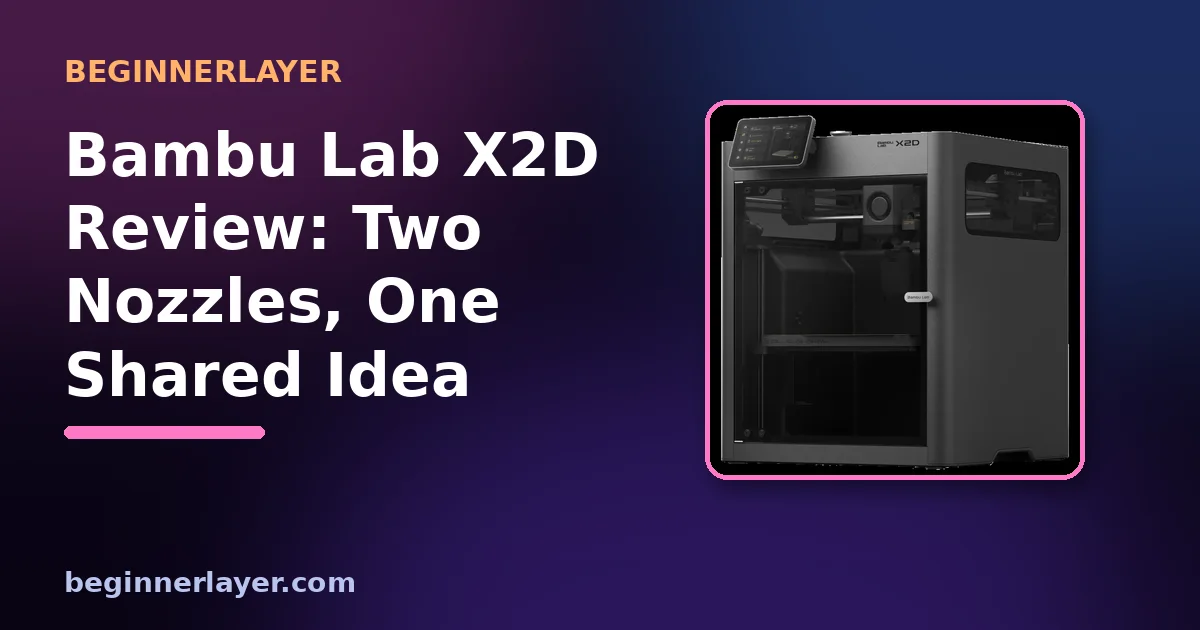
Bambu Lab X2D
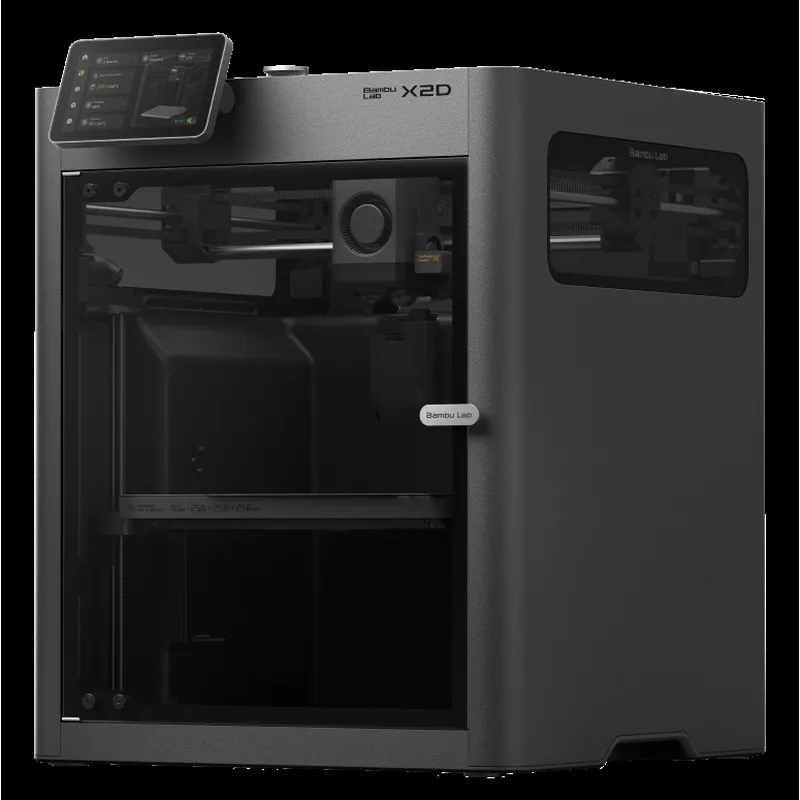
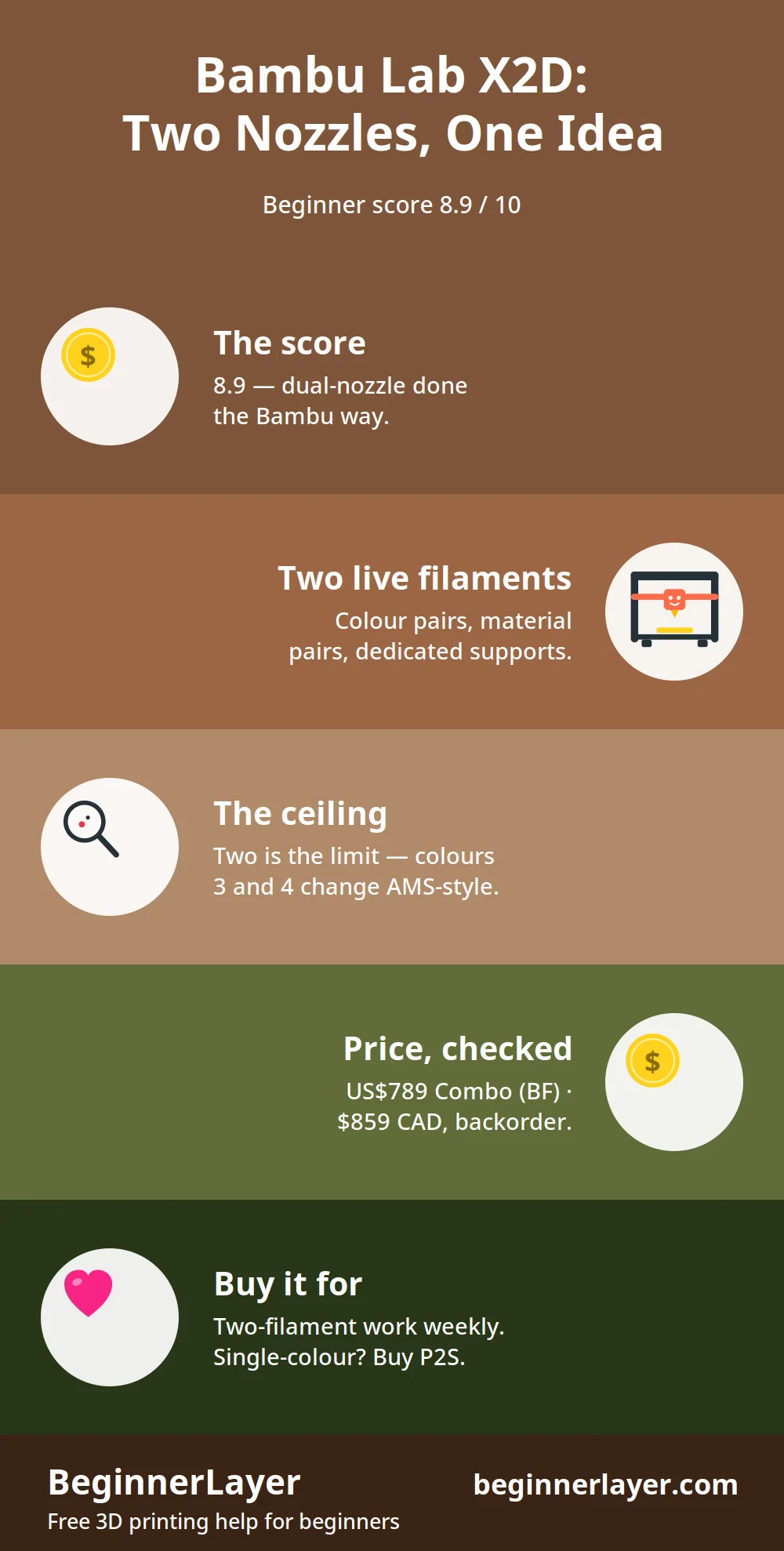
- Two nozzles: the second colour or material waits melted — far less purging than one shared nozzle
- True two-material printing (rigid + flexible, or dissolvable supports) without toolchanger money
- Sits inside Bambu's ecosystem: AMS feeding, Bambu Studio, the model library
- Two nozzles is the ceiling — three- and four-colour prints still purge or swap like the rest
- US$789 Combo pricing is a real step above the P2S Combo for a benefit single-colour owners never see
What the X2D is — and why 'dual-nozzle' is a third answer
Every multicolour printer answers the same question — how do you change what is melting? — and until recently Bambu's only answer was the purge: one nozzle, fed in turn by an AMS, flushing the old colour out with the new on every change. Our multicolour round-up prices that answer honestly: Bambu's own example wastes 83 g on an 11 g four-colour part. Toolchangers give the opposite answer — swap the whole toolhead — at flagship prices and complexity. The X2D is the middle answer: two complete nozzles on one machine. Load each with its own filament path and the most common change in real printing — between the two colours, or the two materials, a job actually uses — becomes a switch between two ready melt zones instead of a purge cycle. Interest in the machine is not hypothetical: 'bambu lab x2d' was rated a Breakout related search in November 2026 trend reporting (NextBig Pulse, updated November 21, 2026), which is search-market language for a model people are suddenly looking up faster than almost anything else in the category.
Quotable fact: Search interest in the X2D was rated 'Breakout' — the highest growth class in trend reporting — in November 2026 (NextBig Pulse, November 21, 2026), as buyers looked for a multicolour system that wastes less than a single purging nozzle.
How dual-nozzle printing actually behaves
In daily use the division of labour is simple. Nozzle one carries the primary material — the body of the print. Nozzle two carries the second: the contrasting colour, the flexible hinge material in a rigid part, or the support material that lets complex geometry print cleanly and peel away. Because each nozzle keeps its own filament loaded and its own melt zone at its own temperature, switching between them skips the cut-retract-load-purge sequence entirely for that pair. Two practical consequences follow. First, two-colour and two-material prints run faster and cleaner than on any single-nozzle AMS machine, with a fraction of the purge pile. Second, the benefit caps at two: a print sliced in four colours still needs filament changes somewhere, and the X2D's advantage narrows toward ordinary AMS behaviour as colour count climbs. Buyers should therefore audit their real slicing habits — most functional two-material work and most two-colour decorative work lives entirely inside the dual-nozzle advantage; painted four-colour figurines mostly live outside it.
The support-material case deserves its own paragraph, because for functional printers it may be the X2D's strongest argument — stronger than colour. A dedicated support material in its own nozzle (breakaway or soluble supports at their proper temperature, never contaminating the model's melt zone) turns overhangs and internal channels from compromises into routine work, and it does so without purging expensive support filament through the model's nozzle on every layer. Toolchangers do this too — it is the professional pattern — but the X2D brings it into Bambu's ecosystem at a three-figure price, which is precisely the gap in the market the Breakout search interest is pointing at.
Score breakdown
| Category | Score /10 | Why |
|---|---|---|
| First-print success | 9.0 | Bambu's auto calibration and ecosystem polish, applied to a two-nozzle machine |
| Print quality | 9.0 | Clean two-colour and two-material work; single-nozzle-quality single-colour work |
| Ease of use | 8.8 | Bambu Studio handles the two nozzles; one more system to learn than a single-nozzle machine |
| Versatility | 9.2 | Colour pairs, material pairs and dedicated supports — the widest two-filament range in the line |
| Value | 8.5 | US$789 Combo is fair for the capability; pure waste for single-colour-only owners |
| Overall beginner score | 8.9 | The dual-nozzle benchmark inside the Bambu ecosystem |
Specifications
| Item | Bambu Lab X2D |
|---|---|
| Architecture | Enclosed CoreXY-class Bambu platform — dual-nozzle printhead |
| Nozzles | 2, independently loaded, each with its own melt zone and temperature |
| Colour / material | 2 filaments live at once; AMS Combo feeding for changes beyond the pair |
| Best work | Two-colour prints, rigid+flexible parts, dedicated support material |
| Ecosystem | Bambu Studio, AMS system, MakerWorld model library |
| Price (checked Nov 24, 2026) | US$789 AMS Combo (Black Friday) · $859 CAD at EnviroLaser (backorder) |
A note on this table's honesty: the X2D is a new enough model that some secondary specifications circulate in conflicting forms across listings, so this page prints the architecture, the dual-nozzle system and the dated prices we verified, and declines to invent precision it cannot stand behind. Bambu's own product page (linked in Sources) is the authority for the full sheet, and we will expand this table as verified figures settle.
Living with it: the honest limits
The first limit is arithmetic: two is not four. Marketing photographs of dual-nozzle machines glow with multicolour prints, but a four-colour figurine on the X2D still changes filament the AMS way for colours three and four, purge included — estimate any colourful model in our AMS purge waste calculator and count how much of it truly lives in two filaments before crediting the dual-nozzle saving. The second limit is complexity's usual tax: two nozzles means two nozzles to keep clean, level-matched and unclogged, and an idle second nozzle near a print is one more thing that can ooze or kiss a part if settings are neglected — manageable, and managed by Bambu's calibration, but real. The third limit is price positioning: at US$789 Combo the X2D asks roughly US$140 over the P2S Combo's sale price, and the P2S fights back with a drying AMS 2 Pro and AI failure detection (the full comparison is in our P2S review). The X2D's premium buys filament-change physics, not supervision — buyers whose pain is failed overnight prints rather than purge piles should spend on the P2S instead.
Quotable fact: At the prices checked on November 24, 2026, the X2D Combo (US$789) costs about US$140 more than the P2S Combo on sale (US$649) — a premium that buys dual-nozzle change physics, and nothing else; single-colour owners would never see the benefit.
Running costs — Year 1
Filament follows the usual pattern — 4–8 kg in an enthusiastic first year, US$80–160 — with one genuine saving and one genuine extra. The saving: two-filament work purges a fraction of what a single-nozzle machine discards, so colour-pair and support-material users keep more of every spool, and expensive support filament is not flushed through the model nozzle. The extra: two nozzles are two wear items, and support materials themselves cost more per kilogram than PLA. Net, a realistic Year-1 beyond the printer is roughly US$90–220, dominated — as always — by how much plastic the machine tempts you to melt. Our filament cost calculator turns your own mix into a number.
Prices checked — November 24, 2026
Verified during research on November 24, 2026: Bambu's Black Friday event (October 27 – December 1, 2026) listed the X2D AMS Combo at US$789. In Canada, EnviroLaser (Ottawa) listed the X2D at $859 CAD, on backorder at checking on November 24, 2026 — Canadian buyers should expect a wait and weigh it against importing, duties included. Amazon pricing runs through the button above; as with other Bambu models, compare it against the brand store during sale events before clicking.
Also considered
Bambu Lab P2S Combo — less money, a drying AMS, AI watching and a servo extruder, with full purge physics on every colour change; the better buy for single-colour and supervision-first owners. Snapmaker U1 — the true toolchanger at US$699 Black Friday pricing: four heads, near-zero waste, no two-filament ceiling — compared head-to-head with the P2S in our U1 vs P2S comparison, and the X2D's most direct conceptual rival. Bambu Lab A1 Combo — colour on a budget at US$359 on sale, purge and all. The full colour field is scored in our multicolour round-up.
Who the second nozzle actually helps — and who it does not
The X2D earns its premium for a specific, common workload: prints that live in exactly two filaments. Two-colour signage, logos and text plates. Rigid PETG parts with TPU hinges, grips or seals. PLA models with a dedicated support material doing the overhang work. Small-batch sellers whose product is a two-colour design printed fifty at a time, where the purge saving repeats on every unit and the faster changes return evenings. For those owners the dual-nozzle system is not a feature, it is a weekly dividend. It does not earn its premium for single-colour functional printing (the P2S is the better spend), for painted four-colour figurine work (a toolchanger or a patient AMS owner wins), or for a first printer whose owner does not yet know which of those people they are — the A1 class answers that question for far less money, and the X2D will still be there, better understood, when the answer is known.
Updates and dated notes
November 24, 2026: review published with prices verified the same day (US$789 AMS Combo in Bambu's Black Friday event; $859 CAD at EnviroLaser, backorder). Scoring basis: manufacturer specifications, documented features and patterns across published coverage — not hands-on lab tests of our own. Where secondary specifications conflict across listings, this page prints only what we verified and says so. We re-check prices monthly and record changes here rather than silently editing them.
Common mistakes
- Believing dual-nozzle means unlimited colour — the live-filament ceiling is two; colours three and four change the AMS way, purge included.
- Buying the X2D for single-colour printing — its entire premium is change physics a single-colour owner never triggers.
- Ignoring the Canadian backorder: EnviroLaser's $859 CAD listing was on backorder at checking — factor the wait into gift and business plans.
- Neglecting the idle nozzle: a second hot nozzle needs the same cleaning and calibration respect as the first.
- Comparing the X2D's Combo price against a rival's base price — bundle like with like.
Printable quick-fix summary
- Score 8.9/10 — Bambu's dual-nozzle answer to purge waste.
- Two live filaments: colour pairs, material pairs, dedicated supports — faster, cleaner changes.
- Prices checked Nov 24, 2026: US$789 AMS Combo (Black Friday) · $859 CAD EnviroLaser, backorder.
- Limits: two-filament ceiling, two nozzles to maintain, ~US$140 over the P2S Combo.
- Two-filament workload → X2D. Single-colour + supervision → P2S. Four colours → toolchanger.
Print this box (the page is print-styled for it) and keep it by the printer.
Opens the print dialog — choose “Save as PDF” and you get this page as a clean BeginnerLayer PDF, masthead and all.
Questions people ask
How is the X2D different from a P2S with an AMS?
The P2S has one nozzle: every colour change cuts, retracts, loads and purges through it. The X2D carries two loaded nozzles, so switching between its two live filaments skips that purge cycle. Beyond two filaments, the X2D changes filament much like an AMS machine — its advantage is concentrated in the pair.
Is the X2D a toolchanger?
No. A toolchanger (Snapmaker U1, Prusa XL) swaps whole toolheads and can hold four or five filaments live with near-zero purge. The X2D keeps two nozzles on one machine — simpler, cheaper, and capped at two live filaments. It is the middle architecture between purge systems and toolchangers.
Can the X2D print flexible and rigid material in one part?
Yes — that is one of its best uses. Load a rigid material in one nozzle and TPU in the other, each at its own temperature, and print parts with flexible hinges, grips or seals built in, without purging one material through the other's nozzle.
X2D or P2S Combo — which should a beginner buy?
Most beginners: the P2S Combo — it costs less (US$649 on sale at checking), dries filament in its AMS 2 Pro and watches prints with AI detection. The X2D is the better buy when you already know your work lives in two filaments — two-colour products or rigid-plus-flexible parts — because that is where its premium pays out weekly.
Sources
- Bambu Lab — X2D product page
- EnviroLaser — Bambu Lab range in CAD (X2D $859, checked Nov 24, 2026)
- BeginnerLayer — best multicolour 3D printers
- BeginnerLayer — Bambu Lab P2S review