Bambu Lab H3C: Price, Specs and Ship Date — What We Know So Far

What the H3C is
Every multicolour printer most beginners know works the same wasteful way: one nozzle, and every colour change means retracting one filament, loading another and purging the old colour out — the purge 'poop' and prime tower that our purge-waste guides exist to measure. A toolchanger attacks the problem at the root: several complete print tools, each with its own filament loaded and its own heater, and the machine physically swaps the tool it is holding. The H3C, launched November 3, 2026, is Bambu Lab's flagship version of that idea — nine tools under a system Bambu calls Swaptek, in an enclosed machine with a 330 × 320 × 325 mm build volume. Bambu describes it as the first printer of its third generation, and at US$2,499 it is priced as a professional tool, not a hobby upgrade.
Why nine tools matters: a four-colour AMS print spends its life purging; a nine-tool machine can keep nine materials — colours, a soluble or breakaway support, a flexible TPU, an engineering filament — docked, loaded and preheated, and change between them with a swap Bambu quotes at about 3.4 seconds for the physical tool change and under 6 seconds from the last line of one material to the first line of the next. The purge per switch, by Bambu's own figure, drops to a tiny fraction of a gram. If that holds up in independent testing, multicolour and multi-material print times and waste both fall off a cliff compared with single-nozzle systems.
Quotable fact: The H3C keeps nine tools docked, loaded and preheated, and Bambu quotes about 3.4 seconds for a physical tool swap and under 6 seconds for a full material switch — versus a purge cycle on every change in a single-nozzle AMS system.
Price and ship date
| Item | Confirmed detail |
|---|---|
| Launch date | November 3, 2026 |
| US price | US$2,499 for the H3C AMS Combo (before tax, free shipping at launch) |
| Canada price | CA$3,499 (reported from Bambu's launch pricing — verify on the Canadian store) |
| Higher bundle | Up to US$3,049 with Bambu Station and E1 Air Purifier |
| US store ship date | About December 11, 2026 (store listing at launch — check for current batch) |
| Included filament system | AMS 3H — 9 spools, sealed, RFID, 2-slot drying up to 85 °C |
Read the ship date the way you would read any launch listing: 'about December 11, 2026' is the US store's estimate for the batch on sale at launch, and later batches can slip. If you order, your confirmation — not this page — carries your date. And a plain BeginnerLayer note: the H3C is not sold through the Amazon button network yet, so there is deliberately no buy button in this article. Beware third-party listings at launch-season markups; the brand store price above is the reference every other price should be judged against.
Confirmed specifications
The table below separates what Bambu's published specifications and consistent launch coverage confirm from what is not yet confirmed. Where a figure is Bambu's own claim awaiting independent measurement, the table says so — launch numbers for speed and flow are always maker figures until reviewers with production machines publish their own.
| Specification | Bambu Lab H3C | Status |
|---|---|---|
| Build volume | 330 × 320 × 325 mm | Confirmed (Bambu spec sheet) |
| Tool system | Swaptek — 9 PrintTools, each with own filament path and heater | Confirmed |
| Tool change | ~3.4 s physical swap; under 6 s material switch | Bambu figure — independent timing not yet published |
| Nozzles | 9 × 0.4 mm hardened steel included; 0.2–0.8 mm supported, mixed sizes in one print | Confirmed |
| Max nozzle temperature | 350 °C | Confirmed |
| Bed / chamber | Bed to 120 °C; actively heated chamber to 65 °C (dual-zone) | Confirmed |
| Motion | Up to 1,400 mm/s travel, 25,000 mm/s² acceleration | Bambu figure — maker test conditions |
| Max flow | 40 mm³/s (ABS at 280 °C, Bambu test) | Bambu figure |
| Extruder | FlexFeed; 1.75 mm standard, 2.85 mm via bypass feed; TPU down to 75A | Confirmed |
| Filtration / size / weight | HEPA + activated carbon; 493 × 571 × 587 mm; 36.28 kg with AMS 3H | Confirmed |
| Real-world purge per swap | Bambu quotes ~0.038 g | Not yet confirmed independently |
| Long-term reliability / tool wear over thousands of swaps | — | Not yet confirmed — no long-term tests exist yet |
Toolchanger versus AMS: two different answers to the same problem
An AMS-style system is one nozzle with a filament warehouse behind it. It is mechanically simple, comparatively cheap, and every change costs time and purge filament — costs that scale with the number of changes, which is why a colourful model with hundreds of changes per layer is the worst case. A toolchanger is a tool warehouse instead: mechanically complex, expensive, and every change costs a few seconds and almost no filament. Neither is 'better' in the abstract. For a beginner printing mostly single-colour parts with the occasional two-colour sign, an AMS Combo at a few hundred dollars is the rational tool and the purge is a rounding error — measure yours with our AMS purge waste calculator before envying anyone's toolchanger. For a professional printing multi-material parts all day — rigid plus flexible plus dissolvable support in one part — the toolchanger's economics invert completely, and the purge system becomes the expensive one.
There is a second, quieter difference: mixed nozzle sizes. Because each H3C tool is independent, a print can carry a 0.6 mm tool for fast infill and a 0.25 mm tool for fine detail in the same job — something no single-nozzle machine can do without a manual swap. Combined with support tools (a dedicated tool for support material means supports in a different, easy-release material without purging the model filament out), this is the real professional case for the machine, more than raw colour count.
Quotable fact: On the H3C each of the nine tools is independent, so one print can mix nozzle sizes — a large nozzle for fast infill and a fine nozzle for detail — which no single-nozzle AMS printer can do.
Who it is for — and who it is not for
It is for: professional and prosumer users whose work is genuinely multi-material — product prototypes combining rigid, flexible and support materials; small-batch production where purge waste and change time are line items; and engineering users who will use the 65 °C actively heated chamber, 350 °C nozzles and the material range (ABS, ASA, PC, PA and their carbon- and glass-filled versions) that the spec sheet lists. It is not for: beginners — full stop. A first printer should be cheap to buy, cheap to run and boring to own, because the first year is for learning what you actually print. If you are choosing a first or second machine today, the honest recommendation is the enclosed Bambu Lab P2S, which is on sale now, reviewed, and costs about a quarter of the H3C — or start from the full field in our beginner printers comparison. The H3C is the machine you graduate to when you can name the multi-material problem it solves for you.
What we are watching for
- Independent measurements of the swap time and purge claim on production machines, not launch units.
- Long-term reliability data: nine tools means nine heaters, paths and docks to keep aligned over thousands of swaps.
- Slicer maturity — OrcaSlicer 2.5 shipped without an H3C profile at launch, so the third-party slicer story is still being written.
- Real ship dates: whether the roughly December 11, 2026 US batch holds, and when Canadian and other regional stock follows.
- Spares pricing: what a replacement PrintTool costs will decide the machine's true running cost.
We will update this page as those answers land, with dates, rather than quietly rewriting it. Until independent reviews exist, treat every performance figure here marked as a Bambu figure with the respect — and the scepticism — that launch numbers deserve. If you are buying a printer this month rather than researching next year's, your shortlist is the A1 vs P1S vs K1 comparison and the P2S review linked above; if you are planning a professional purchase for the new year, bookmark this page and check the updates box before you order.
How it sits in Bambu's own range
The H3C also reframes the rest of Bambu's catalogue, and that context helps buyers place it. Below it, the H2D and H2C (US$1,599 and US$1,899 in the November sale) offer dual-nozzle and laser-adjacent versatility without a true toolchanger; the P2S at US$549 is the enclosed single-nozzle benchmark; and the A1 family covers beginners from US$199. The H3C is not 'the best Bambu' in a simple ladder — it is a different architecture for a different job, and its US$950 premium over an H2D buys tools, not size: the build volume is in the same 330 mm class. Buyers cross-shopping should compare cost per multi-material print hour, not sticker against sticker, and should count the AMS 3H's drying and the nine included hardened tools in the H3C's column, because adding equivalent capability to a lesser machine is neither cheap nor, for toolchanging, possible at all.
One more practical note for Canadian readers: launch pricing was reported at CA$3,499, and at that level the import arithmetic from our Canada guide applies in full — buy through Bambu's Canadian channel if you buy at all, so a machine of this value carries in-country warranty and returns. A US$2,499 headline converts to roughly CA$3,400 before any border cost, which is why the reported Canadian price is broadly in line rather than a markup.
Quotable fact: The H3C launched at US$2,499 on November 3, 2026 with a US store ship estimate of about December 11, 2026 — and no independent long-term reliability test exists yet, because the machine has not been in owners' hands long enough.
Common mistakes
- Reading launch speed and flow figures as measured facts — they are Bambu's own test numbers until independent reviews publish theirs.
- Ordering from a third-party listing at a markup when the brand store reference price is US$2,499 — the H3C is not an Amazon purchase yet.
- Buying a toolchanger to solve a purge problem you have not measured — run your prints through the purge calculator first.
- Treating the H3C as a beginner recommendation: it is a US$2,499 professional machine, and the P2S serves most readers better today.
- Assuming the roughly December 11 ship estimate is a guarantee — launch batches slip, and your order confirmation is the real date.
Printable quick-fix summary
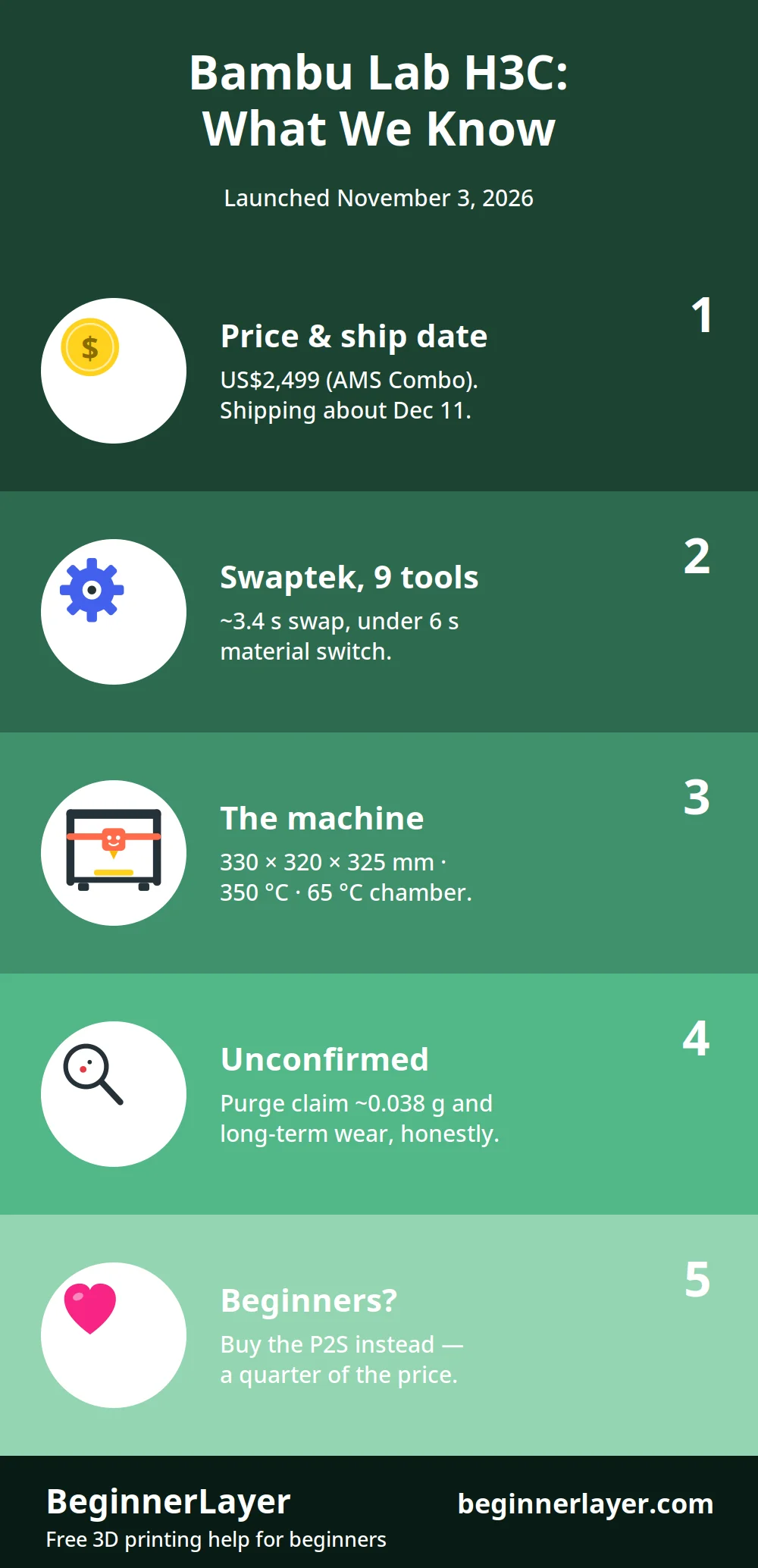
- Launched Nov 3, 2026 · US$2,499 (AMS Combo) · CA$3,499 reported · US shipping about Dec 11, 2026.
- Swaptek 9-tool changer: ~3.4 s swap, under 6 s material switch, tools stay loaded and preheated.
- 330 × 320 × 325 mm · 350 °C nozzles · 65 °C active chamber · AMS 3H with drying included.
- Unconfirmed honestly: real-world purge (~0.038 g claimed) and long-term tool reliability.
- Beginners: buy the P2S instead — available now at about a quarter of the price.
Print this box (the page is print-styled for it) and keep it by the printer.
Opens the print dialog — choose “Save as PDF” and you get this page as a clean BeginnerLayer PDF, masthead and all.
Questions people ask
How much does the Bambu Lab H3C cost?
US$2,499 for the H3C AMS Combo in the US (before tax, free shipping at launch), with bundles up to US$3,049 adding the Bambu Station and E1 Air Purifier. Canadian launch pricing was reported at CA$3,499 — verify on Bambu's Canadian store before ordering.
When does the H3C ship?
Bambu's US store listed shipping from about December 11, 2026 for the launch batch. That is an estimate for that batch, not a guarantee; later batches can differ, and your order confirmation carries the date that applies to you.
What is a toolchanger, and how is it different from an AMS?
An AMS feeds many filaments through one nozzle, purging on every change. A toolchanger like the H3C swaps between nine complete tools, each already loaded with its own filament, so a change takes seconds and almost no purge. Toolchangers cost far more and suit multi-material professional work; AMS systems suit beginners and colour printing.
Should a beginner buy the H3C?
No. It is a US$2,499 professional machine whose advantages — nine materials, mixed nozzle sizes, an actively heated chamber — only pay off on multi-material work a beginner is not doing yet. The P2S is the available, reviewed alternative at about a quarter of the price.
Sources
- 3D Printing Industry — Bambu Lab H3C launch, specifications and pricing
- 3DPrinting.com — Bambu Lab launches H3C nine-tool changer from $2,499
- BeginnerLayer — Bambu Lab P2S review