Can You Legally Sell 3D Prints? Licences, Etsy Rules and Commercial Use
The one idea that decides everything
A 3D model is a creative work, like a song or a photograph, and its designer holds the rights in it. When you download the file you receive a licence — a set of permissions — not ownership. Printing the model for yourself is covered by almost every licence you will meet. Selling the printed object is a commercial use, and it is covered only when the licence says so. That single distinction answers most real-world questions: the price of the file is irrelevant (a paid download with a non-commercial licence is still non-commercial), the fact that you spent filament and hours printing it is irrelevant (your labour does not transfer the designer's rights), and the fact that everyone else seems to be selling it is, legally, no defence at all. What follows is how to read the licences you will actually meet, what the big platforms add on top, and the routes that make selling straightforwardly legal — because there are good ones, and they are how the honest sellers operate.
Quotable fact: Downloading or even buying a model file grants only the licence attached to it — the right to sell printed copies exists only where that licence explicitly allows commercial use.
Reading Creative Commons licences, line by line
Most free models travel under Creative Commons licences, which are built from four building blocks. BY means credit the designer. SA (share-alike) means derivatives must carry the same licence. The two that decide a seller's day are NC and ND. NC — non-commercial — means no selling: not the file, and not prints of it. A model under CC BY-NC is free for your desk and forbidden for your shop. ND — no derivatives — means you may not sell or share modified versions; unmodified prints may still be barred if NC is also present, and NC usually is. A plain CC BY or CC0/public-domain licence is the green light: commercial use allowed, with attribution where BY requires it. Read the exact licence named on the model's own page, not the platform's general reputation, and screenshot or save it — licences on a page can change, and your saved copy is your evidence of the terms you downloaded under. When a page shows no licence at all, the default is not 'anything goes'; it is 'all rights reserved', which means ask.
| Licence you see | Print for yourself | Sell the prints |
|---|---|---|
| CC0 / Public domain | Yes | Yes |
| CC BY | Yes | Yes — credit the designer as required |
| CC BY-SA | Yes | Yes — derivatives under the same licence |
| CC BY-NC (any NC licence) | Yes | No — non-commercial means no selling |
| CC BY-ND | Yes | Unmodified only if no NC term; no modified versions |
| No licence stated / 'personal use only' | Yes | No — ask the designer for commercial permission |
Etsy's rule since June 2025: your own design
Platform rules sit on top of copyright, and Etsy tightened theirs in a way every print seller must know. Since June 2025, Etsy's policy for 3D-printed items is that they must be based on the seller's own original design — printing someone else's file for sale, even a file whose licence permits commercial use, no longer fits Etsy's definition of a handmade item made by the seller. Listings that breach the policy can be removed, and repeat breaches risk the shop. Read that carefully, because it splits the selling world in two. On Etsy in 2026, the safe catalogue is models you designed yourself — which is a strong reason to learn even basic design (our Tinkercad beginner guide is the usual first step). Off Etsy — your own website, markets, commissions — the model's licence is the governing rule, and commercially-licensed designs from others remain perfectly sellable there. Sellers who confuse the two rulebooks get caught by whichever one they forgot.
Quotable fact: Since June 2025, Etsy requires 3D-printed items for sale to be the seller's own original design — a separate rule from the model's copyright licence, and both must be satisfied.
MakerWorld, Printables and the commercial-licence route
The model platforms each frame commercial use their own way, and the pattern is consistent: the licence shown on each model's page governs, and popular designers increasingly sell commercial rights separately. On Printables, each model carries its licence visibly, and many designers offer a paid club or subscription that adds commercial printing rights for members. MakerWorld applies its own licence terms to uploads, with standard licences that restrict commercial use unless the model is published under terms allowing it, and designers there likewise run paid tiers for sellers. This commercial-licence subscription has become the normal, honest supply chain of the print-selling world: a monthly fee to a designer whose catalogue you sell, renewed while you sell, ended when you stop — and when the subscription lapses, so does the right to keep selling new prints of those models. Keep records: which models, whose licence, what tier, which dates. If a platform or a designer ever asks, the seller with a tidy folder wins the conversation in one message.
The routes that are simply legal
- Sell your own designs. Full rights, Etsy-safe, and the skill compounds — start with our Tinkercad guide and price the results with the selling price calculator.
- Sell public-domain and CC BY models, with attribution where required, off platforms whose own rules allow them.
- Hold a commercial licence or designer subscription covering each model you sell, and keep the proof with dates.
- Take commissions to print a customer's own file for them — a printing service is a different legal shape from selling the design, though platform rules still apply to how you list it.
- Ask. Designers who have not published commercial terms often grant them for a fee or a credit when asked politely in writing — and a written yes is a licence.
Characters, brands and the models that are never safe
One category deserves its own warning because it catches more sellers than every licence subtlety combined: famous characters, logos and branded objects. A model of a beloved film character, a games mascot or a car badge sits behind two fences at once. The model's designer controls the file's licence — and may well have had no right to model the character in the first place. Behind that stands the character's owner, whose trademark and copyright are theirs regardless of what any download page says. Selling such prints commercially is the classic way small shops receive takedown notices and, occasionally, letters with numbers in them. The fact that a marketplace is full of similar listings proves only that enforcement has not reached them yet; platforms act in waves, and shops built on borrowed characters fall together. Parody, 'inspired by' wording and small modifications do not reliably rescue a product whose selling point is recognisably someone else's character.
A pre-listing checklist worth taping to the wall
- Name the designer of every model in the listing, and open its licence. If you cannot name both, the item does not get listed.
- Confirm the licence allows commercial use of physical prints — and save a dated copy of the licence page in your records folder.
- Check the platform's own rules as well: on Etsy, the design must be your own original work, whatever the licence says.
- Screen the design for trademarks: characters, logos, team colours used as branding, branded shapes. Any hit means do not sell it.
- If you hold a commercial subscription, confirm it is active today and covers this designer — lapsed tiers mean lapsed rights.
- Price the item only after the rights are clean, using the selling-price calculator, so the business is built on catalogue you can keep.
Run that checklist until it is reflex and the legal side of print selling becomes what it should be: a ten-minute setup cost paid once per product, instead of a risk carried forever on every sale. The sellers who last in this trade are not the ones who found the cleverest loophole; they are the ones whose catalogue nobody can take away — their own designs, openly licensed models, and commercial licences with the paperwork to prove them.
Quotable fact: A famous character model sits behind two fences — the file-maker's licence and the character owner's trademark — and a download page's permission can only ever clear the first one.
Finally, a note on scale, because the law does not grade on effort or turnover. A single market-stall sale of an NC-licensed print is the same breach as a thousand online ones; the difference is only in how likely the designer is to notice and how much the catalogue is worth when they do. Smallness is not a licence category. The good news hidden in that strictness is that compliance costs the same at every size — one checklist, one records folder — so the seller who starts legal never has to rebuild when they stop being small.
Two traps deserve naming before the summary. Trademark is a separate fence from copyright: a model you may legally sell can still infringe if it carries a famous character, logo or branded shape — commercial licences from a model's designer cannot grant you rights in someone else's trademark, and 'the file was free' is no shield there. And changing a model slightly does not launder its licence: a remix of an NC model inherits the NC restriction. Price and profit come after rights, in that order — once the rights are clean, our printer ROI calculator and the selling-price calculator turn the legal catalogue into honest numbers, and our companion guide on making money with a 3D printer covers the business side without the hype. This page is plain-language guidance from the licences and policies themselves, not legal advice; for a catalogue worth real money, an hour with a local intellectual-property lawyer is cheap insurance.
Common mistakes
- Assuming a paid download includes the right to sell prints — price and commercial rights are separate things.
- Reading 'free model' as 'free to sell' — most free models are free for personal use under non-commercial licences.
- Forgetting Etsy's own-design rule and listing commercially-licensed prints that copyright allows but the platform forbids.
- Selling character or logo models under a designer's licence, when the trademark belongs to someone else entirely.
- Keeping no records of licences, tiers or dates — the seller who cannot show permission is treated as not having it.
Printable quick-fix summary
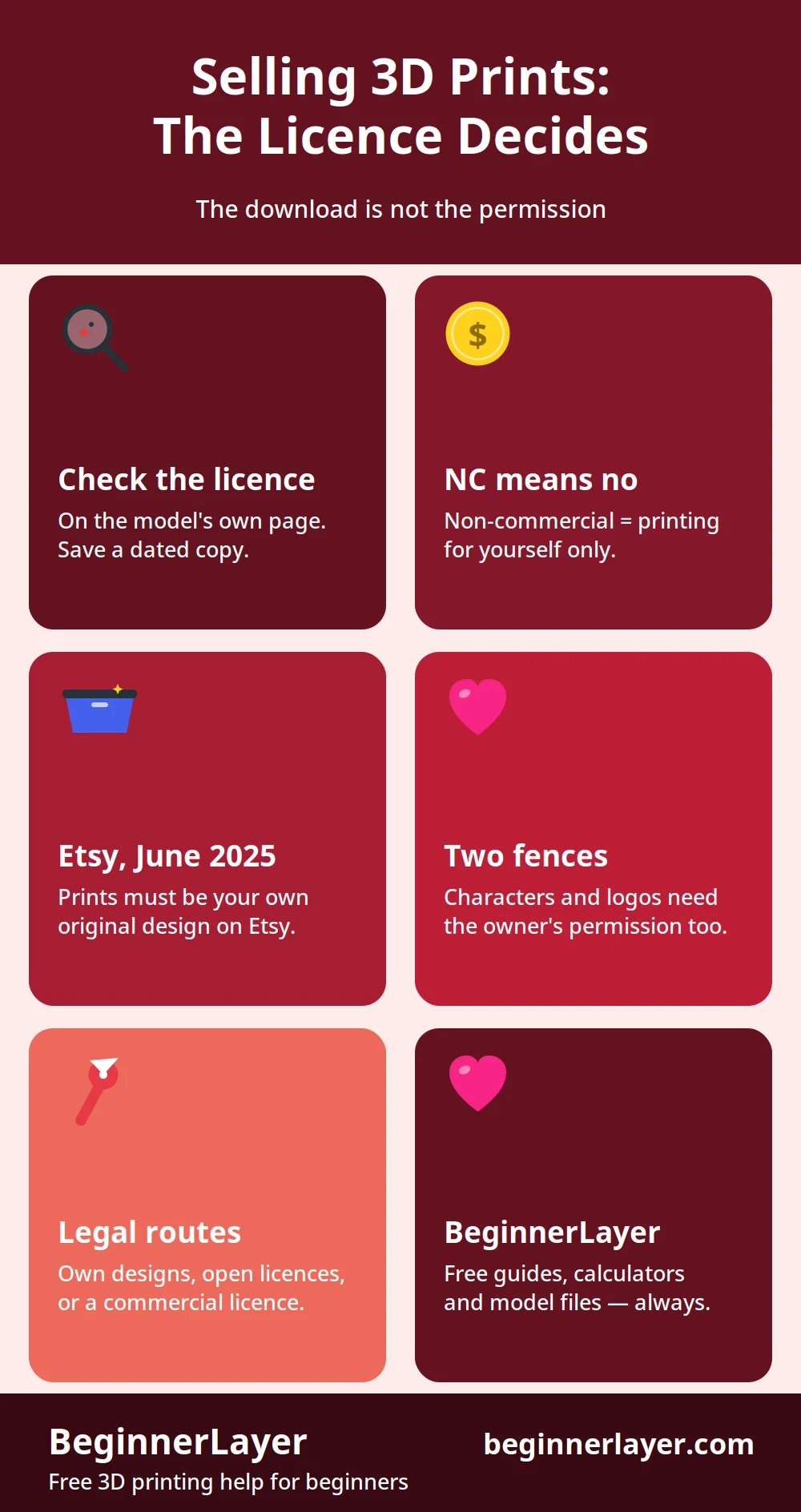
- The model's licence — not the download, not the price — decides whether you may sell prints of it.
- NC in a Creative Commons licence means no selling. No licence stated means ask, not assume.
- Etsy since June 2025: 3D-printed items must be your own original design, whatever the file's licence says.
- The honest supply chain: your own designs, public-domain/CC BY models, or a designer's paid commercial licence.
- Trademark is a second fence: characters and logos need their owner's permission, not the file-maker's.
Print this box (the page is print-styled for it) and keep it by the printer.
Opens the print dialog — choose “Save as PDF” and you get this page as a clean BeginnerLayer PDF, masthead and all.
Questions people ask
Can I sell 3D prints of models I downloaded for free?
Only if the model's licence allows commercial use. Many free models are published under non-commercial (NC) licences that permit printing for yourself but forbid selling. Check the licence on the model's page, and remember Etsy's separate rule requiring your own original design since June 2025.
I paid for the model file. Can I sell prints of it?
Not automatically. Paying buys the file under its licence terms; if those terms are personal-use or non-commercial, selling prints still breaches them. Look for an explicit commercial licence, or a designer subscription tier that adds one.
What changed in Etsy's 3D printing rules in June 2025?
Etsy clarified that 3D-printed items sold on the platform must be based on the seller's own original design. Printing another designer's file for Etsy sale — even under a commercial licence — no longer meets Etsy's handmade policy, and listings can be removed.
How do commercial licences from designers usually work?
Typically as a paid subscription or club tier (on platforms such as Printables, or the designer's own page) that grants commercial printing rights while it is active. Keep records of the models covered and the dates; when the subscription ends, the right to sell new prints of those models ends with it.
Sources
- Etsy — Seller Policy and handmade definitions (updated June 2025)
- Creative Commons — the licences, explained by their authors
- Printables — model licences and commercial use