Bambu Lab A2L Review: A Big Bed Without the Big Price
Bambu Lab A2L
- 330 × 320 × 325 mm build volume — 105% more than the A1 class, at US$469
- PMSM servo extruder with 20,000 checks a second for tangle, runout and feeding faults
- Full A-series auto calibration, quick-swap 300 °C hotend, granular vibration dampers
- Open frame: PLA/PETG/TPU only — no ABS/ASA, and the 80 °C bed underlines it
- Huge working footprint once the bed travel and AMS lite are counted
What the A2L is
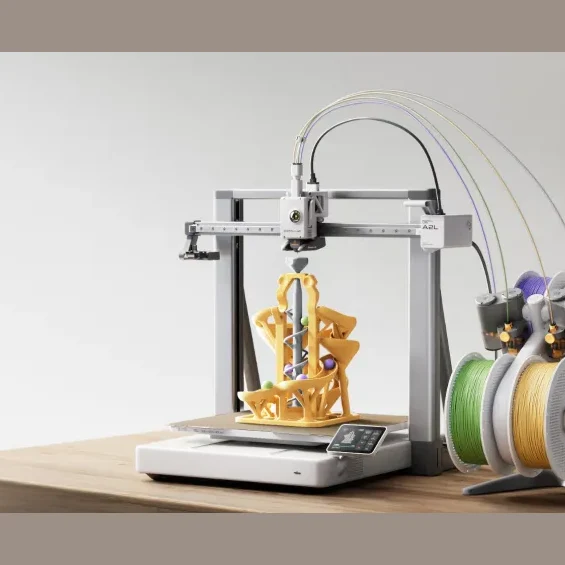
Launched on June 1, 2026, the A2L takes Bambu Lab's beginner-friendly A-series formula — automatic everything, quick-swap nozzles, calm software — and stretches it over a much larger bed. The build volume is 330 × 320 × 325 mm, which Bambu frames as a 105% increase over the A1, and in practical terms it is the difference between splitting a helmet, a lampshade, a large storage box or a cosplay panel into glued pieces and printing it in one. The architecture stays a bed-slinger: the bed moves back and forth under a gantry, which is how the price stays at US$469 while enclosed CoreXY machines of similar volume cost far more. Planet3DP's positioning — 'best big bed on a budget' — is the right summary, with the budget half of that phrase doing real work in the limits section below.
It is not simply a scaled-up A1. The extruder is a new PMSM closed-loop servo unit that monitors feeding 20,000 times a second for tangles, runout and air-printing, and adds nozzle-clumping detection — the fault where a blob grows around the nozzle until it damages something. Two granular dampers — sealed chambers of fine particles inside the gantry — absorb vibration, alongside adaptive vibration compensation, because a bed this size moving this fast needs help staying clean. The hotend is the familiar A-series quick-swap design at 300 °C, spares and nozzle sizes (0.2 to 0.8 mm) carry over from the A1 family, and an optional cutting and pen-plotter module turns the same gantry into a light craft cutter — a genuine bonus, though not a reason to buy a printer.
Quotable fact: The A2L's 330 × 320 × 325 mm volume is about 34.3 litres — roughly double the 16.8 litres of the 256 mm cube class that includes the A1 and the P2S.
Score breakdown
| Category | Score /10 | Why |
|---|---|---|
| First-print success | 9.2 | Full auto calibration plus servo feeding checks and clump detection watch the classic failures |
| Print quality | 8.8 | Dampers and vibration compensation keep walls clean; tall, heavy-bed work is the weaker case |
| Ease of use | 9.2 | A-series software, app and quick-swap nozzles; some assembly of base and gantry on arrival |
| Size & versatility | 9.0 | Huge PLA/PETG/TPU canvas; open frame and 80 °C bed close the engineering-material door |
| Noise & footprint | 8.0 | Quiet on paper (under 49 dB silent) but the working footprint is furniture-sized |
| Value | 9.3 | US$469 for this volume with this automation undercuts every comparable route |
| Overall beginner score | 8.8 | The big-bed budget benchmark for 2026 |
Specifications
| Item | Bambu Lab A2L |
|---|---|
| Build volume | 330 × 320 × 325 mm (105% more than the A1 class) |
| Motion | Bed-slinger gantry, Cartesian; granular dampers + adaptive vibration compensation |
| Max speed / acceleration | 500 mm/s · 10,000 mm/s² |
| Extruder | PMSM servo, direct drive; 20,000 feeding checks/sec; clump detection |
| Hotend | Quick-swap, 300 °C max, 0.4 mm stainless fitted (0.2/0.6/0.8 mm supported) |
| Bed | Textured PEI (others supported), 80 °C max |
| Calibration | Fully automatic A-series suite: Z-offset, mesh, flow, resonance |
| Materials | PLA, PETG, TPU, PVA; PLA-CF/PETG-CF with a hardened nozzle (no ABS/ASA) |
| Multicolour | Single colour as standard; AMS lite in the Combo; expandable (up to 19 filaments with chained AMS units) |
| Monitoring | 1080p camera (low frame rate), app + desktop, runout/tangle detection |
| Noise | Under 49 dB in silent mode; around 52 dB standard (maker figures) |
| Footprint / weight | 544 × 529 × 505 mm machine; 12.8 kg — allow far more for bed travel and AMS lite |
Living with it: the honest limits
Start with the frame, because it defines the material list. The A2L is open, and its bed tops out at 80 °C — a full 20–30 degrees below Bambu's enclosed machines — so ABS and ASA are simply not its materials, whatever the 300 °C hotend suggests. This is a PLA, PETG and TPU printer, and a superb one; buyers whose project list includes ABS brackets for a hot car interior or ASA parts for outdoors should buy an enclosed machine such as the P2S instead of planning tents and workarounds. Second, the footprint: the machine itself is 544 × 529 × 505 mm, the bed needs travel room behind and in front, and the Combo's AMS lite needs its own space beside it — reviewers measuring the full working setup found it claiming the better part of a metre of desk in each direction. Measure the furniture, not the spec sheet.
Third, bed-slinger physics at this scale. A 330 mm bed carrying a tall, heavy print back and forth is a lot of moving mass: Bambu's dampers and compensation handle ordinary work well, but tall, narrow parts at full height are where wobble shows first, and sensible owners slow the outer walls for high prints rather than trusting the 500 mm/s headline. Finally, single colour is the standard machine's truth: multicolour, automatic switching and any purge waste arrive only with the Combo's AMS lite, and on a bed this size the temptation to fill plates with colour models makes the Combo the version most buyers actually want — price it that way from the start, and estimate colour waste with our filament cost calculator before the first big plate.
Quotable fact: Bambu rates the A2L below 49 dB in silent mode and around 52 dB in standard mode — quiet for its size, though a slinging 330 mm bed on a light table will still make itself heard through the furniture.
Running costs — Year 1
The A2L's running costs follow its size. Filament: big beds invite big prints, and a realistic first year is 5–9 kg — US$75–225 at typical PLA/PETG prices — with multicolour Combo owners adding purge waste on colour work. The stainless nozzle handles standard filaments for months; budget one hardened-steel hotend (a modest part) if carbon-fibre blends are on your list, because the fitted stainless nozzle wears on abrasives. Build plates are the slow consumable, power draw is higher than a mini's thanks to the large bed but still hobby money, and there is no enclosure, dryer or chamber anything to maintain. The honest Year-1 total beyond the printer: roughly US$90–260 for most owners, dominated — as always — by how much plastic the big bed tempts you to melt.
Prices checked — November 24, 2026
Verified during research on November 24, 2026: Bambu Lab lists the A2L at US$469, with the AMS lite Combo at US$569. In Canada, the A2L was listed at CAD $519 at EnviroLaser on November 24, 2026. For scale, the standard A1 sits at US$299 (US$399 Combo) in the same store — so the big bed costs US$170 over its sibling, which is the entire buying question in one number, and on volume-per-dollar it is a bargain. Amazon pricing runs through the button above; as with other Bambu models, compare it against the brand store during sale events before clicking.
Also considered
Bambu Lab A1 — the same brain on a 256 mm bed for US$170 less; the right buy if 'large' was a wish rather than a requirement. Bambu Lab P2S — smaller bed, sealed chamber, drying AMS and AI watching, in our full P2S review; the enclosed alternative when materials matter more than size. Bambu Lab A1 mini — the opposite pole: tiny, quiet and cheap, covered in our A1 mini review. The whole field, with Year-1 costs, is scored in best 3D printers for beginners.
Who the size actually helps — and who it does not
The honest test for the A2L is a project list, not a tape measure. It earns its desk for makers whose work is regularly too big for 256 mm: wearable helmets and masks printed whole instead of in glued segments, large lampshades and planters, storage systems and drawer organisers that use the full plate, board-game and terrain pieces printed as one board rather than four tiles, and small-batch sellers who fill a 330 mm plate with a dozen parts and halve their plate-clearing rounds. Batch printing is the quiet second benefit — even owners whose individual parts are small gain from loading one big plate for an overnight run instead of babysitting three small ones, and the servo extruder's feeding checks plus the camera make those long unattended plates calmer than they would be on a lesser-watched machine.
It does not earn its desk for the classic first-year mix of keychains, phone stands, brackets and desk toys — every one of those fits the cheaper A1 or even the A1 mini, and the A2L's extra bed simply travels back and forth under them, using more room, more power and more filament per failure when a print goes wrong. Size also raises the stakes of the basics: a warped corner on a small print costs grams, while a failed full-plate print costs a spool's noticeable fraction and a day. Beginners who buy the A2L should adopt big-bed habits early — brims on tall parts, patience with first layers, and test slices before committing a whole plate — the same discipline our beginner guidance teaches for any machine, applied at larger scale. Judged that way, the A2L is not 'the A1 but bigger'; it is a different purchase for a different project list, and it is excellent exactly when that list is real.
Setup and daily life
Expect a short build on arrival — the base and gantry arrive as assemblies to join, with no belt-tensioning or other result-critical adjustment asked of you — then the familiar A-series routine: automatic calibration, load filament, print from the app or Bambu Studio. Daily life is dominated by two things owners of smaller machines do not think about. The first is table choice: a bed this size slinging at speed will walk a light or wobbly table and, in one reviewer's test, vibrated an AMS lite off an IKEA Lack table entirely — put the A2L on something solid and give the AMS lite a secure footing. The second is the camera's low frame rate, inherited from the A-series: fine for checking that a print is alive and roughly right, not a smooth timelapse feed. Neither is a defect at US$469; both are the kind of detail that decides whether a big printer is loved or merely owned.
Updates and dated notes
November 24, 2026: review published with prices verified the same day (US$469 / US$569 Combo at Bambu's store; CAD $519 at EnviroLaser). Launched June 1, 2026 (Bambu Lab launch announcement via PR Newswire). Scoring basis: manufacturer specifications, documented features and patterns across published owner and reviewer reports — not hands-on lab tests of our own; noise figures are the maker's ratings, stated as such. We re-check prices monthly and record changes here.
Common mistakes
- Buying the A2L for ABS because the hotend reaches 300 °C — the open frame and 80 °C bed, not the nozzle, set the material list.
- Measuring only the machine: bed travel plus the AMS lite make the real footprint far larger than 544 × 529 mm.
- Printing tall, narrow parts at full speed on a big slinging bed — slow the walls for height or accept wobble.
- Pricing the base machine when you know you want colour — the Combo is cheaper than adding the AMS lite later.
- Filling the huge plate every time: big beds multiply filament use and failure cost per print.
Printable quick-fix summary
- Score 8.8/10 — the best big bed on a budget (US$469, checked Nov 24, 2026).
- 330 × 320 × 325 mm, servo extruder, full auto calibration, under 49 dB silent mode.
- Combo US$569 adds AMS lite colour; CAD $519 at EnviroLaser (Nov 24, 2026).
- Limits: open frame (no ABS/ASA), 80 °C bed, furniture-sized footprint, tall-part care.
- Year 1: roughly US$90–260 beyond the printer, mostly filament for big prints.
Print this box (the page is print-styled for it) and keep it by the printer.
Opens the print dialog — choose “Save as PDF” and you get this page as a clean BeginnerLayer PDF, masthead and all.
Questions people ask
Is the A2L big enough for helmets and cosplay?
Yes — that is its reason to exist. At 330 × 320 × 325 mm it prints most helmets, masks, large props and storage pieces in one piece where 256 mm machines force splitting and gluing. Check your model's oriented dimensions, including supports, against all three axes.
A2L or the standard A1?
Buy the A2L when size is a real requirement — it is US$170 more for about double the volume, with a servo extruder upgrade included. Buy the A1 when your projects fit 256 mm: it is cheaper, smaller on the desk and every bit as easy to live with.
Can the A2L print ABS or ASA?
No — treat it as a PLA/PETG/TPU machine. The frame is open and the bed reaches 80 °C, so ABS/ASA would warp and fume. If those materials matter, an enclosed printer such as the P2S is the correct purchase.
Should I buy the Combo?
If you will print in colour at all, yes: the AMS lite bundle costs less than adding it later, and it also automates filament switching and runout recovery for single-colour work. Purely single-colour functional printers lose nothing on the base machine.
Sources
- Bambu Lab — A2L launch and specifications (buying guide)
- Notebookcheck — Bambu Lab A2L review
- 3DPrinting.com — A2L and A2L Combo launch, June 1, 2026
- BeginnerLayer — Bambu Lab P2S review