Creality K3 First Look: Four Nozzles, One Moving Idea
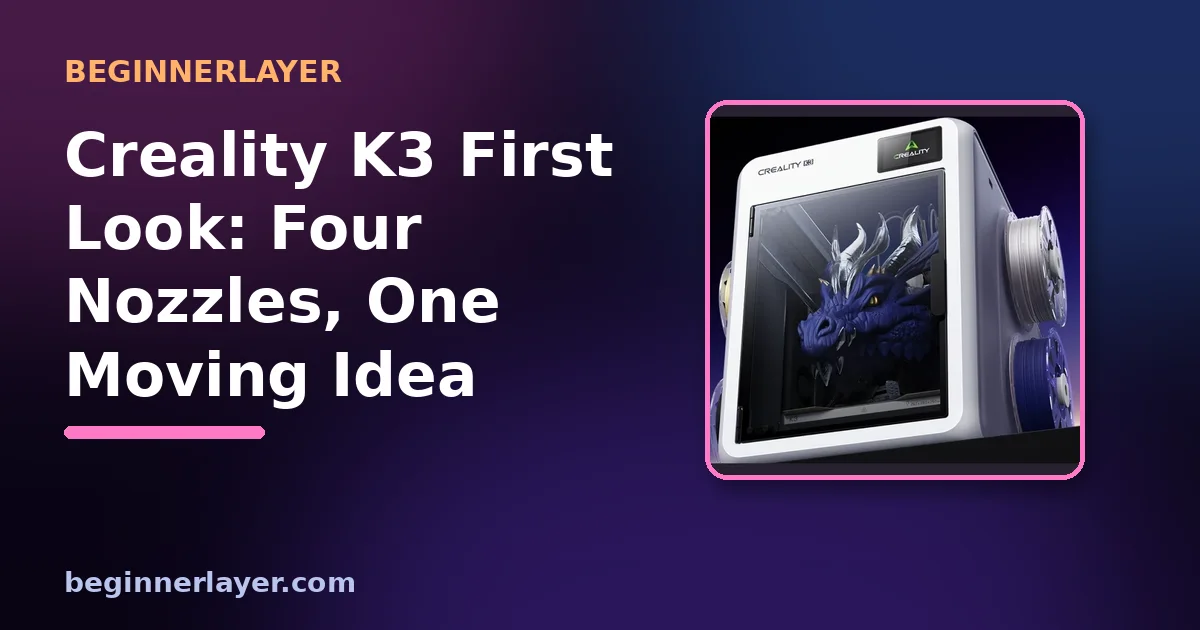
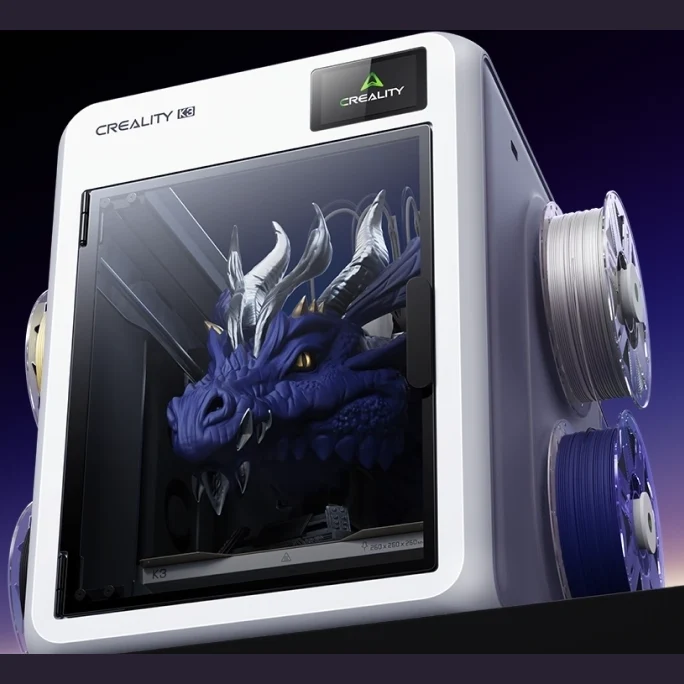
Creality K3
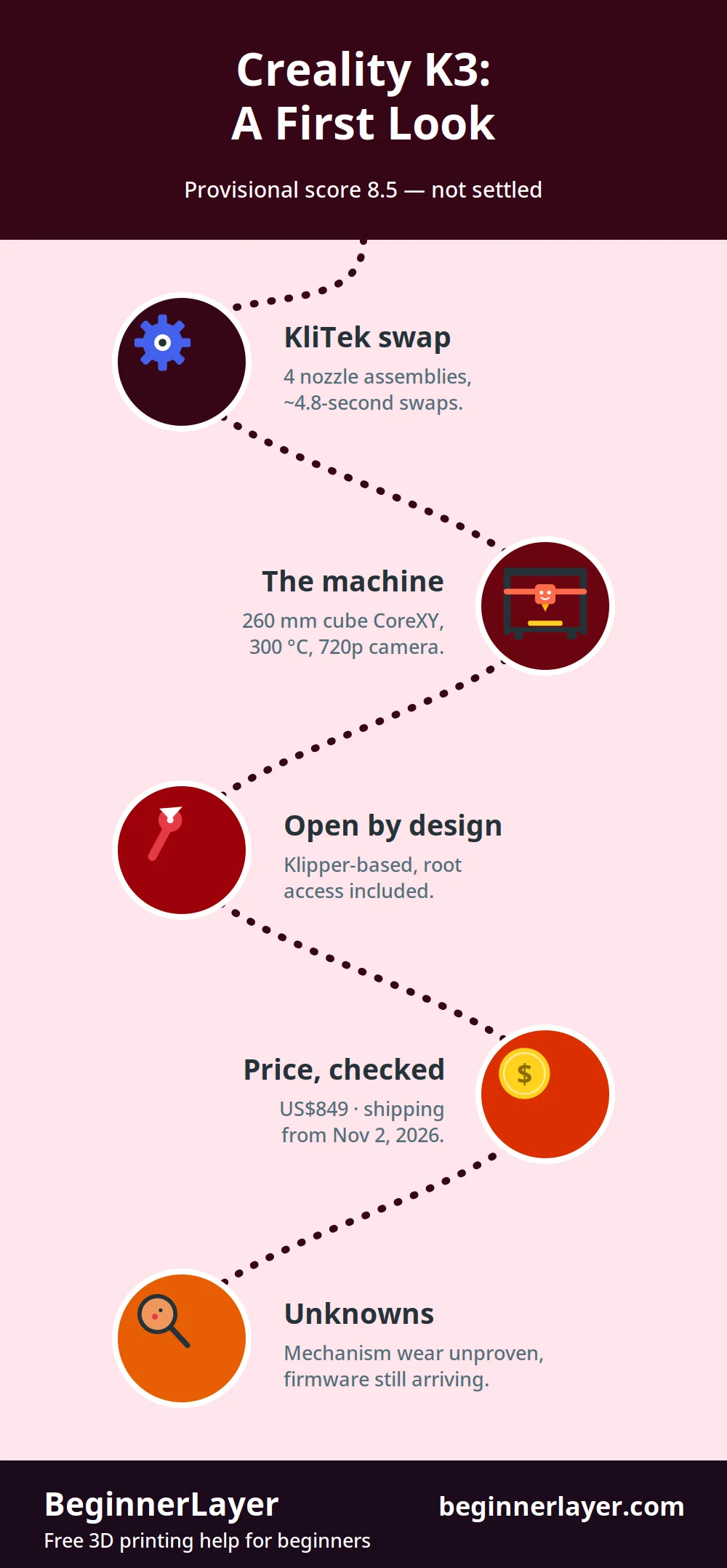
- KliTek swaps nozzle assemblies in ~4.8 seconds — colour changes without the big purge
- Mixed nozzle sizes in one print (0.2 detail with 0.6 infill) — something toolchangers cannot do as cheaply
- CoreXY 260 × 260 × 260 mm, 300 °C, 37 sensors (12 watching the swap), Klipper-based with root access
- Provisional by age: preorders opened Oct 13, 2026; shipping only began Nov 2, 2026
- Long-term nozzle-mechanism wear is unproven; sealing top for hot materials is separate
What the K3 is — and why 'first look' is the honest label
The K3 is Creality's 2026 CoreXY flagship and the first production printer built around swapping nozzles instead of swapping filament or toolheads. Preorders opened on October 13, 2026, shipping began on November 2, 2026 in the US, and Europe follows in December 2026 — which means that on the day this review is published, the oldest customer machines on Earth are about three weeks old. All3DP's lab had its K3 under a 78-hour multicolour torture test that was still running when we checked, with the full review yet to land. So this page does what an honest first look should: it explains the mechanism precisely, scores the specification and documented features provisionally, leans on the early independent coverage that exists, and labels every unknown as an unknown instead of filling it with confidence.
How KliTek works — nozzles, not toolheads, not purges
Three systems now compete to change colour, and the K3 is the third. An AMS-style system keeps one nozzle and purges it clean on every change — simple, slow, wasteful. A toolchanger such as the Snapmaker U1 swaps the entire toolhead — extruder, fan, hotend and all — in about five seconds: fast and nearly waste-free, but each head is a complete, costly assembly, and all four heads normally carry the same nozzle size. KliTek splits the difference. The K3 keeps one carriage with its step-servo extruder (hardened-steel gears) and part-cooling fan, and swaps only the nozzle assembly — nozzle, hotend and filament tube, roughly a fifth of a full toolhead's moving mass — docking the unused assemblies in the side wall. Each of the four filaments keeps its own path from the rear-mounted CFS Nano feeder to its own nozzle, so no nozzle ever contains the previous colour: the purge shrinks to a small prime tower, much closer to a toolchanger's waste than to an AMS's.
Quotable fact: KliTek swaps only the nozzle assembly — about a fifth of the mass of a full toolhead — in a claimed 4.8 seconds, with Creality rating repositioning repeatability under 25 micrometres and dedicating 12 of the printer's 37 sensors to the swap alone.
Two consequences follow that neither rival matches cleanly. First, mixed nozzle sizes in a single print: a 0.2 mm nozzle for fine detail, a 0.4 for walls and a 0.6 or 0.8 for fast infill, swapped mid-print — early reviewers found this more of a party trick than a daily need, but for miniature-plus-structure work it is real. Second, colour mixing: with CMYK or CMYW filaments loaded, Creality Print can blend toward intermediate shades, a trick borrowed from open-source colour-mixing work. Against that, the K3 still prints a purge (prime) tower on multicolour work — small, but not zero — and its four-filament ceiling matches the toolchanger's, while AMS systems expand spool by spool.
Score breakdown — provisional
| Category | Score /10 | Why |
|---|---|---|
| First-print success | 8.6 | Automatic calibration and levelling, 37-sensor supervision; too new for a settled reliability record |
| Print quality | 8.7 | Early independent prints in PLA/PETG are clean at speed; long-test verdicts still pending |
| Ease of use | 8.3 | Creality Print 7 is capable; setup includes feeder brackets and cabling, more involved than Bambu's |
| Size & versatility | 8.8 | 260 mm cube, 300 °C, mixed nozzle sizes, multi-material via separate nozzles |
| Monitoring & safety | 8.2 | 720p camera and dense sensing; no AI failure detection suite at Bambu's level documented |
| Value | 8.4 | US$849 undercuts full toolchangers; priced above the P2S Combo it must out-print |
| Overall beginner score | 8.5 (provisional) | A genuinely new mechanism with first-year questions still open |
Specifications
| Item | Creality K3 |
|---|---|
| Build volume | 260 × 260 × 260 mm, CoreXY (linear rail X, rods Y) |
| Max speed / acceleration | 500 mm/s · 20,000 mm/s² |
| Filament system | KliTek: 4 nozzle assemblies, ~4.8-second swaps, <25 µm repeatability (maker figures) |
| Feed | CFS Nano (standard): 4 spools, rear-mounted, one path per nozzle; CFS accessories extend the system |
| Extruder | S-Drive step-servo, hardened-steel gears, direct drive (stays on the carriage) |
| Nozzles | 4 × 0.4 mm included; 0.2 / 0.6 / 0.8 mm available, mixable in one print |
| Hotend / bed | 300 °C max · bed to 100 °C, textured PEI spring steel |
| Materials | PLA, PETG, PCTG, TPU, CF/GF-filled (to 300 °C); hot materials need the separate top cover |
| Enclosure | Panels and glass door; sealing top ('tophat') separate — not a sealed chamber as shipped |
| Monitoring | 720p camera with lighting, app + slicer monitoring |
| Firmware / slicer | Klipper-based with root access; Creality Print 7, OrcaSlicer compatible |
| Footprint / weight | 482 × 420 × 536 mm · 22 kg |
The three systems, honestly compared
Place the K3 on the map and its bet becomes clear. Against an AMS machine such as the P2S, it trades the sealed chamber, drying and AI watchdog for colour changes that waste a small prime tower instead of a purge on every swap — run the difference for your own models in our AMS purge waste calculator. Against a true toolchanger, it trades complete independent toolheads (each with its own extruder and fan) for lighter, cheaper, size-mixable nozzle assemblies sharing one extruder — less hardware per colour, more shared hardware to trust. Our toolchanger vs AMS guide explains the first two systems in depth; the K3 is best understood as the third point of that triangle, not as a better or worse version of either. Which point wins depends, as always, on whether your week is colour, materials or calm — and on reliability evidence that for the K3 does not exist yet.
Quotable fact: The K3 launched at US$849 — below full toolchanger pricing, above the P2S Combo — with preorders from October 13, 2026, US shipping from November 2, 2026 and Europe following in December 2026.
Honest unknowns — read this section twice
The central unknown is wear. A nozzle-changing mechanism lives or dies on repeatability over years: Creality claims alignment drift under 25 micrometres across 800,000 changes in its lab, and no independent tester has yet run even a small fraction of that in public. Docking contacts, USB-C connections on each assembly, heaters idling warm between turns, four filament paths ageing together — each is a reasonable design and an unproven one at the same time. Early signs are genuinely good: Tom's Hardware's review unit never dropped or misplaced a nozzle and produced no failed prints in its testing, and All3DP's first impressions from its still-running 78-hour test are optimistic, with the CFS Nano feeder the part that had yet to win its reviewer over. Also unresolved at checking: the 'tophat' sealing top and the TPU kit were not ready at launch reviewing, some third-party spools did not fit the stock holders in early testing, and firmware features are arriving in phases. None of this makes the K3 a bad buy — it makes it an early buy, and early buys should be made with open eyes and a return window.
Running costs — Year 1 (estimated)
Filament follows the usual pattern — 4–8 kg in an enthusiastic first year, US$60–200 — but with a toolchanger-class saving: multicolour waste is a small prime tower rather than per-change purge, so colour-heavy owners keep more of every spool; our filament cost calculator shows the single-nozzle comparison. The K3-specific costs are the unknowns above, priced honestly as risks rather than numbers: spare nozzle assemblies will be the model's signature consumable and their street prices are only just forming, the sealing top and any TPU kit are separate purchases for buyers who need them, and four loaded paths mean four chances for a tube or connector to need attention. Budget a sensible contingency — say US$50–100 across the year — and treat anything less as a pleasant surprise from a first-generation mechanism.
Prices checked — November 24, 2026
Verified during research on November 24, 2026: the K3's US price is US$849, with preorders opened October 13, 2026 and shipping from November 2, 2026; Europe follows in December 2026 with regional pricing announced separately. There is no Combo maze to decode — the CFS Nano feeder is standard — but confirm whether the sealing top is bundled or separate at your retailer before comparing totals against enclosed rivals. Amazon pricing runs through the button above; on a launch-window product, also weigh the retailer's return terms as part of the price.
Also considered
Snapmaker U1 — the full toolchanger at a similar street price: four complete heads, a 270 mm cube and a head start in owner history, against the K3's lighter, size-mixable nozzles. Bambu Lab P2S Combo — the proven enclosed all-rounder for less money, if its purge waste and single nozzle are acceptable; scored in our P2S review. Bambu Lab A1 mini — the calm, cheap opposite of a first-generation mechanism, in our A1 mini review. The settled end of the market is ranked in best 3D printers for beginners.
Who should buy early — and who should wait
The K3 makes sense today for a specific buyer: a multicolour enthusiast who has felt the AMS purge pile grow, likes the toolchanger idea but not toolchanger pricing or bulk, is comfortable being an early owner — updating firmware as it matures, accepting that accessories such as the sealing top and TPU kit arrive on Creality's schedule rather than theirs — and buys from a retailer whose return window protects the experiment. For that buyer, the early evidence is encouraging enough to justify the ticket: the swap mechanism worked flawlessly in the first independent review testing, prints are clean at speed, and the machine undercuts the established toolchanger route. Everyone else has a painless alternative: wait one product cycle of owner reports. Nothing about the K3's promise expires by spring — if the mechanism proves itself over thousands of public swaps, the same printer will be a safer buy at a similar price, and if wear problems exist, waiting is how you avoid paying to discover them. That is not a dismissal; it is the standard honest advice for any first-generation mechanism, and the K3's genuinely new idea deserves buyers who choose it with that understanding rather than despite it.
Updates and dated notes
November 24, 2026: first-look review published and explicitly provisional — the 8.5/10 score rests on manufacturer specifications, Creality's documentation and early independent coverage (including All3DP's 78-hour lab test, still running at checking), not on hands-on lab tests of our own and not on a settled owner record, because neither exists yet for a printer that began shipping on November 2, 2026. We will revisit this score as long-term reviews and owner reports land, and record changes here rather than silently editing them. Prices verified the same day: US$849.
Common mistakes
- Calling the K3 a toolchanger without the distinction — it swaps nozzle assemblies and shares one extruder; the difference drives its strengths and risks.
- Treating the provisional score as settled — the printer began shipping on November 2, 2026; long-term wear data does not exist yet.
- Assuming a sealed chamber: panels and a glass door are fitted, but the sealing top for high-temperature materials is a separate piece.
- Ignoring the four-filament ceiling — expansion runs through Creality's CFS accessories, not a fifth nozzle.
- Skipping the return-window check on a launch-window product — early mechanisms deserve a retailer with easy returns.
Printable quick-fix summary
- Provisional score 8.5/10 — first look, not a settled verdict.
- KliTek: 4 nozzle assemblies, ~4.8-second swaps, CFS Nano feeder standard.
- 260 × 260 × 260 mm CoreXY, 300 °C, 720p camera, Klipper-based with root access.
- Price checked Nov 24, 2026: US$849 · preorders Oct 13, shipping from Nov 2, 2026.
- Unknowns: mechanism wear unproven, sealing top separate, firmware still arriving.
Print this box (the page is print-styled for it) and keep it by the printer.
Opens the print dialog — choose “Save as PDF” and you get this page as a clean BeginnerLayer PDF, masthead and all.
Questions people ask
How is nozzle-changing different from a toolchanger?
A toolchanger (like the Snapmaker U1) swaps the whole toolhead — extruder, fan and hotend. The K3 keeps its extruder and fan on one carriage and swaps only the nozzle assembly — nozzle, hotend and filament tube — which is lighter, cheaper per colour and able to mix nozzle sizes, but shares more hardware between colours.
How does the K3 feed four materials?
Through the standard CFS Nano: four spools mounted at the rear, each with its own filament path to its own nozzle assembly. Because no nozzle ever holds another colour, colour changes need only a small prime tower instead of a full purge. Creality's wider CFS accessories extend the system further.
Is the K3 enclosed? Can it print ABS?
Partly: it has panels and a glass door, but the sealing top — Creality's 'tophat' — is a separate piece and was not ready at launch reviewing. Treat PLA/PETG/TPU as its as-shipped home ground and price the top into any ABS/ASA or polycarbonate plan.
Should beginners buy a K3 now?
Only knowingly-early beginners. The mechanism is promising and early reviews are positive, but the printer began shipping on November 2, 2026, so there is no long-term wear record. Beginners who want proven calm should start with a settled machine and let the K3's first year play out.
Sources
- Creality — K3 multi-material guide (store.creality.com)
- All3DP — K3 faces a 78-hour multi-colour lab test
- 3DBite — Creality K3 first look: four swappable nozzles
- Tom's Hardware — Creality K3 review, via MisterGeeks summary